Nanjing, Jiangsu Jun 25, 2026 (Issuewire.com) - The landscape of emergency response and firefighting has undergone a profound transformation over the past two decades, driven by a shift from passive protective gear to proactive, life-saving technical ecosystems. At the core of this evolution is the modern breathing apparatus, which has transitioned from a mechanical gas cylinder into a fully networked life-support console. Established in March 2004, Nanjing ZHENGZE Technology Co., Ltd. has spent over twenty years specializing in the research, development, and manufacturing of intelligent emergency rescue equipment. As an original equipment manufacturer (OEM) with a dedicated research and development team, over 100 core patents, and a high-capacity 5,000-square-meter manufacturing facility, the company operates as a premier Trusted SCBA Supplier globally. By integrating advanced communication systems, digital telemetry, and sensory enhancements directly into firefighter gear, modern technical architectures have dramatically elevated both operational efficiency and personal safety during high-risk entry operations.
To better understand how these advancements operate under real-world conditions, industrial safety engineers and fire service specialists frequently evaluate the specialized technologies embedded within modern personal protective equipment. The integration of Heads-Up Displays (HUD), continuous physiological telemetry, and long-wave infrared sensory equipment represents the current benchmark for high-performance safety gear. Below, we address the most frequently asked questions regarding how these sophisticated sub-systems function, how they resolve historical operational limitations, and how they are structurally implemented within cutting-edge life support platforms.
Q1: How does a Heads-Up Display (HUD) improve situational awareness within a modern SCBA mask, and what are its key operational parameters?
In traditional fire environments, checking remaining cylinder pressure required a first responder to manually look down at a chest-mounted mechanical pressure gauge or a digital console. This physical action diverts attention away from immediate hazards, limits hand availability, and becomes exceptionally difficult in zero-visibility conditions due to heavy smoke accumulation. A Heads-Up Display addresses these hazards by projecting critical operational metrics directly onto the user's peripheral visual field inside the facepiece, ensuring completely hands-free monitoring.
Modern HUD systems use a series of multi-colored, ultra-bright LED modules or miniature digital displays mounted within the interior frame of the breathing mask. The primary metric transmitted is real-world cylinder pressure, usually divided into clear visual thresholds:
- Full to Three-Quarters Capacity: Indicated by a stable green light matrix, signifying safe operational duration.
- One-Half Capacity: Transitioning to a yellow visual indicator, signaling that the operation has reached its midpoint.
- One-Quarter Capacity (Critical Threshold): A rapid flashing red light indicator accompanied by a synchronized haptic or audible low-pressure alarm, signaling immediate evacuation requirements.
The structural architecture of a high-performance system, such as the Intelligent Self-Contained Breathing Apparatus (SCBA) developed by ZHENGZE, ensures that these optical indicators remain visible regardless of external ambient lighting or internal mask condensation. The data is transmitted wirelessly via low-power radio frequencies from a digital pressure transducer attached to the cylinder regulator directly to the mask display assembly. This eliminates external wiring that could present an entanglement hazard in confined structural collapses. Power consumption is highly optimized, with integrated lithium batteries providing over 50 hours of continuous active tracking on a single charge cycle, ensuring reliability through extended multi-alarm incidents.
Q2: What is the technical mechanism behind Vital Sign Monitoring in rescue equipment, and how does it safeguard personnel?
During intense physical exertion in high-temperature environments, emergency personnel are exposed to extreme physiological strain, including rapid dehydration, severe heat exhaustion, and sudden cardiovascular events. Cardiovascular failure remains a leading cause of duty-related fatalities among firefighters. Integrating continuous biometric tracking directly into the respiratory apparatus provides a continuous baseline of individual health metrics, shifting incident command from reactive emergency response to predictive medical intervention.
The tracking mechanism utilizes non-invasive optical and biometric sensors embedded into the components that maintain direct contact with the responder's body. These contact zones typically include the fabric of the harness straps, the interior forehead cushion of the helmet, or the flexible sealing skirt of the silicone face mask.
- Photoplethysmography (PPG): Miniature optical sensors emit specific wavelengths of light into the superficial capillary pathways of the skin, measuring light absorption variations to calculate real-time heart rate and blood oxygen saturation (SpO2) levels.
- Core Temperature Estimation: Thermistor arrays monitor localized heat exchange and skin-temperature fluctuations, utilizing algorithmic modeling to estimate internal core temperature trends.
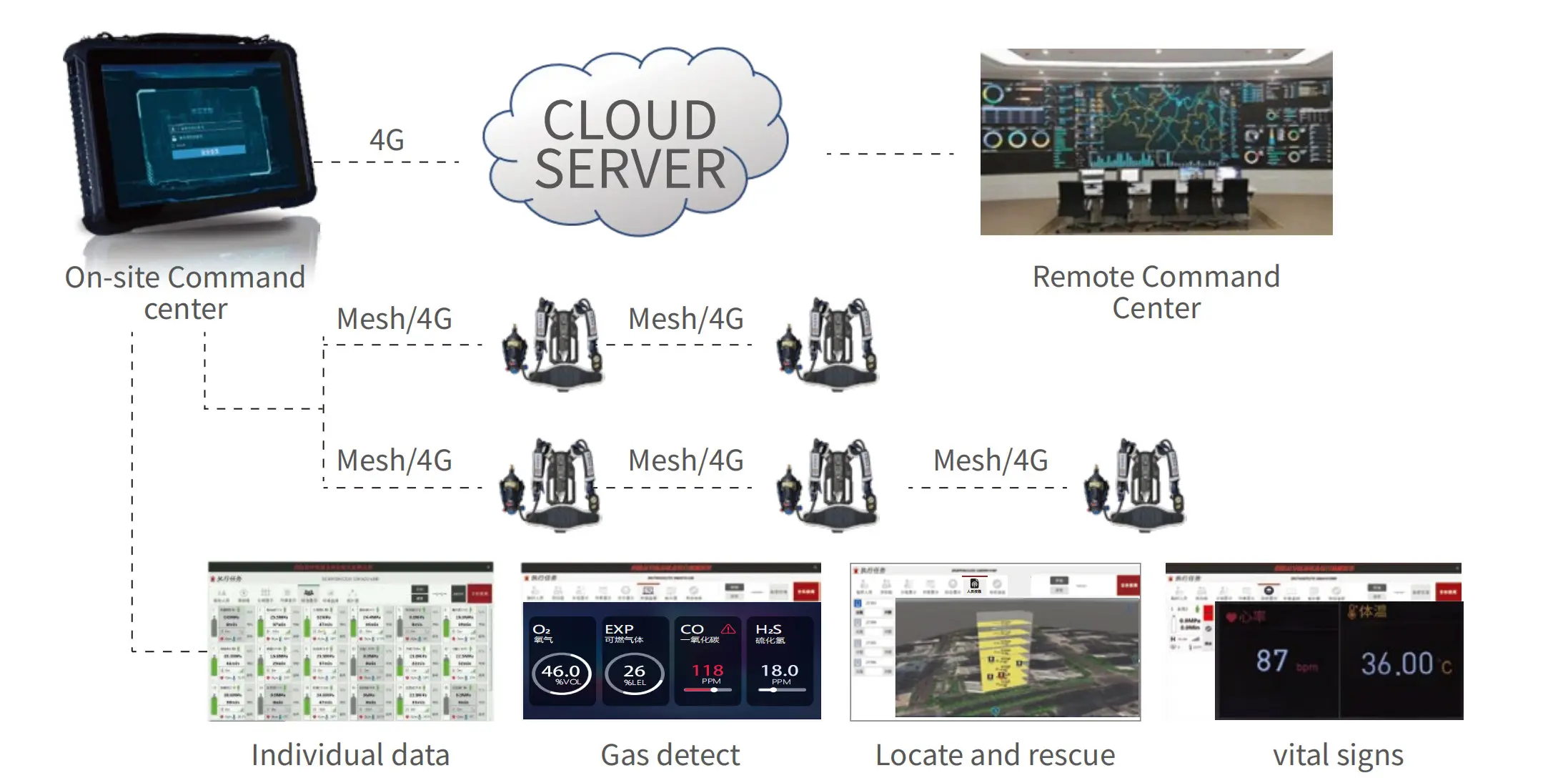
The gathered biometric data is processed instantly by an onboard central processing micro-unit mounted within the SCBA backframe. It is then transmitted via long-range ad-hoc wireless communication modules back to a centralized command dashboard located outside the hazard zone. Incident commanders can monitor the real-time physical strain profiles of every deployed team member simultaneously. If a rescuer's heart rate exceeds a predetermined safe threshold (e.g., 180 beats per minute for a sustained duration) or if their blood oxygen saturation drops dangerously low, the remote dashboard triggers an automatic alert. This allows the command to order an immediate rotation or extraction before the individual suffers physical collapse or permanent injury.
Q3: How is Integrated Thermal Imaging synthesized within breathing apparatuses to overcome zero-visibility environments?
Thick, toxic smoke particulate is one of the most immediate threats to navigating a structure's interior, completely blocking natural light and rendering standard sight useless. Handheld thermal imaging cameras have long been used to locate victims and identify structural hot spots, but they require the operator to dedicate one hand entirely to holding the device, limiting their ability to handle fire hoses, carry rescue tools, or maintain physical contact with team lines.
Integrating thermal imaging directly into the SCBA architecture solves this mechanical limitation. A miniaturized long-wave infrared (LWIR) camera sensor is mounted externally on the top or side profile of the helmet or mask assembly. This sensor detects thermal radiation signatures rather than visible light, allowing it to see clearly through thick smoke, dust, and absolute darkness.
The captured thermal imagery is translated into a clear real-time video feed. This feed is projected onto a micro-display positioned at the lower edge of the user’s vision or integrated directly into the HUD optics. The wearer receives a continuous thermal map of their immediate surroundings superimposed over their field of vision. Key technical specifications of these integrated modules include:
- Uncooled Focal Plane Arrays: Utilizing a standard resolution format (such as 240 by 180 or 384 by 288 pixels) to deliver high thermal sensitivity with minimal lag.
- Dynamic Refresh Rates: Operating at 25 Hz or 30 Hz to ensure fluid image capture during fast head movements.
- Colorized Temperature Gradients: Implementing precise color mapping where high-temperature zones (such as structural weak points or hidden fire pockets) are rendered in bright orange and red shades, while cooler zones (including trapped civilians or exit paths) appear in distinct gray or blue tones.
By maintaining hands-free access to a continuous thermal landscape, rescue teams can accelerate search-and-rescue timelines by up to 50 percent, quickly locate downed personnel, and immediately spot structural flashover indicators before they occur.
Q4: How do intelligent SCBA systems consolidate these separate data streams into a single, unified emergency communication framework?
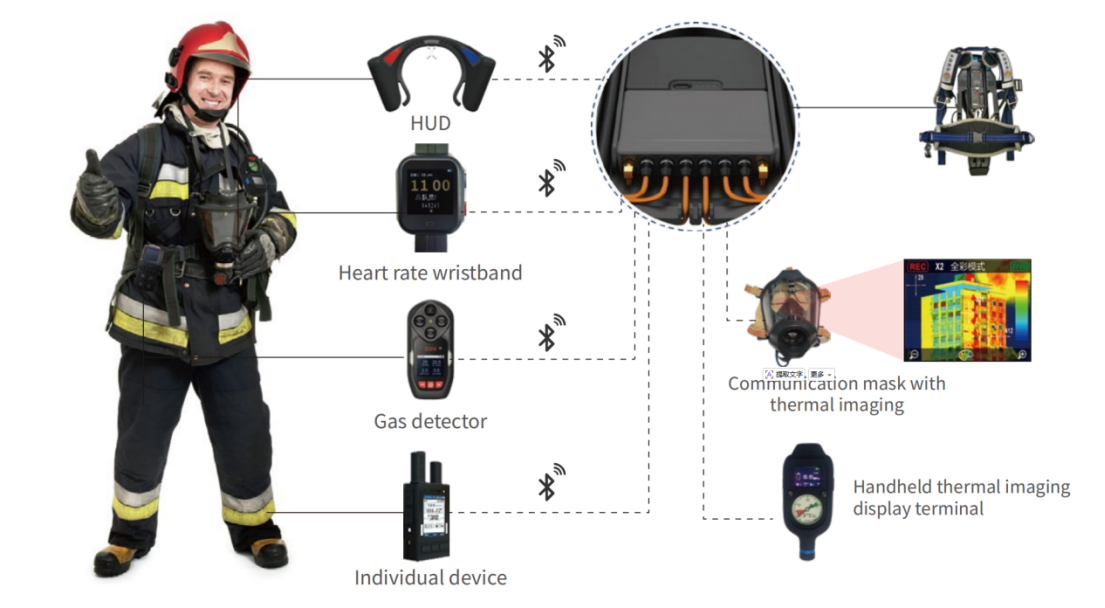
The true value of modern rescue equipment does not lie in running isolated technical features, but in its ability to combine HUD data, vital sign analytics, and thermal imagery into a cohesive communication framework. Without full system integration, rescuers would be overwhelmed by disparate alarms, while incident commanders would lack a clear, unified view of the ongoing operation.
An advanced intelligent platform accomplishes this synthesis by utilizing a centralized smart hub embedded directly within the backframe of the apparatus. This hub acts as the operational brain, collecting data from the cylinder pressure transducer, the mask-integrated HUD, the biometric body sensors, and the external thermal imaging unit.
This sensor data is organized and prioritized using automated software algorithms. Critical safety metrics—such as low air volume or dangerous physiological spikes—are immediately pushed to the top of the processing queue. The consolidated data packet is then broadcast outward via an integrated digital wireless transceiver. This transceiver utilizes multi-frequency mesh networking protocols, which automatically create dynamic communication relays between individual rescuers inside a structure. If a concrete wall blocks a direct signal to the outside command post, the data packet automatically hops from one rescuer's SCBA unit to another until it reaches the rear command monitoring terminal.
Furthermore, these smart systems are built to adapt to specific operational needs. As a comprehensive provider, companies can customize functional profiles, redesign structural housing elements, create tailored injection molds, and navigate complex international regulatory certifications for global deployments. This ensures that the digital data gathered by the equipment can be fully integrated with existing regional command-and-control software platforms, providing a seamless flow of intelligence from the deep interior of a disaster site all the way to regional emergency management headquarters.
Conclusion
The integration of smart systems within self-contained breathing apparatuses marks a major milestone in the history of emergency management technology. By turning a basic respiratory shield into an intelligent, data-driven life-support platform, modern systems provide rescue personnel with the visual, physical, and sensory clarity needed to operate safely in unpredictable environments. For global markets and specialized rescue agencies seeking rigorous structural design, customized functionality, and validated safety performance, working alongside an established developer ensures that frontline personnel remain protected by the very pinnacle of modern industrial safety engineering.
To explore further technical specifications, customized equipment design services, or to view the complete catalog of intelligent emergency rescue platforms, please visit the official enterprise interface.
Enterprise Website: https://www.zhengzesafety.com/
Media Contact
Nanjing Zhengze Technology Co., Ltd. info@nj-zhengze.com




