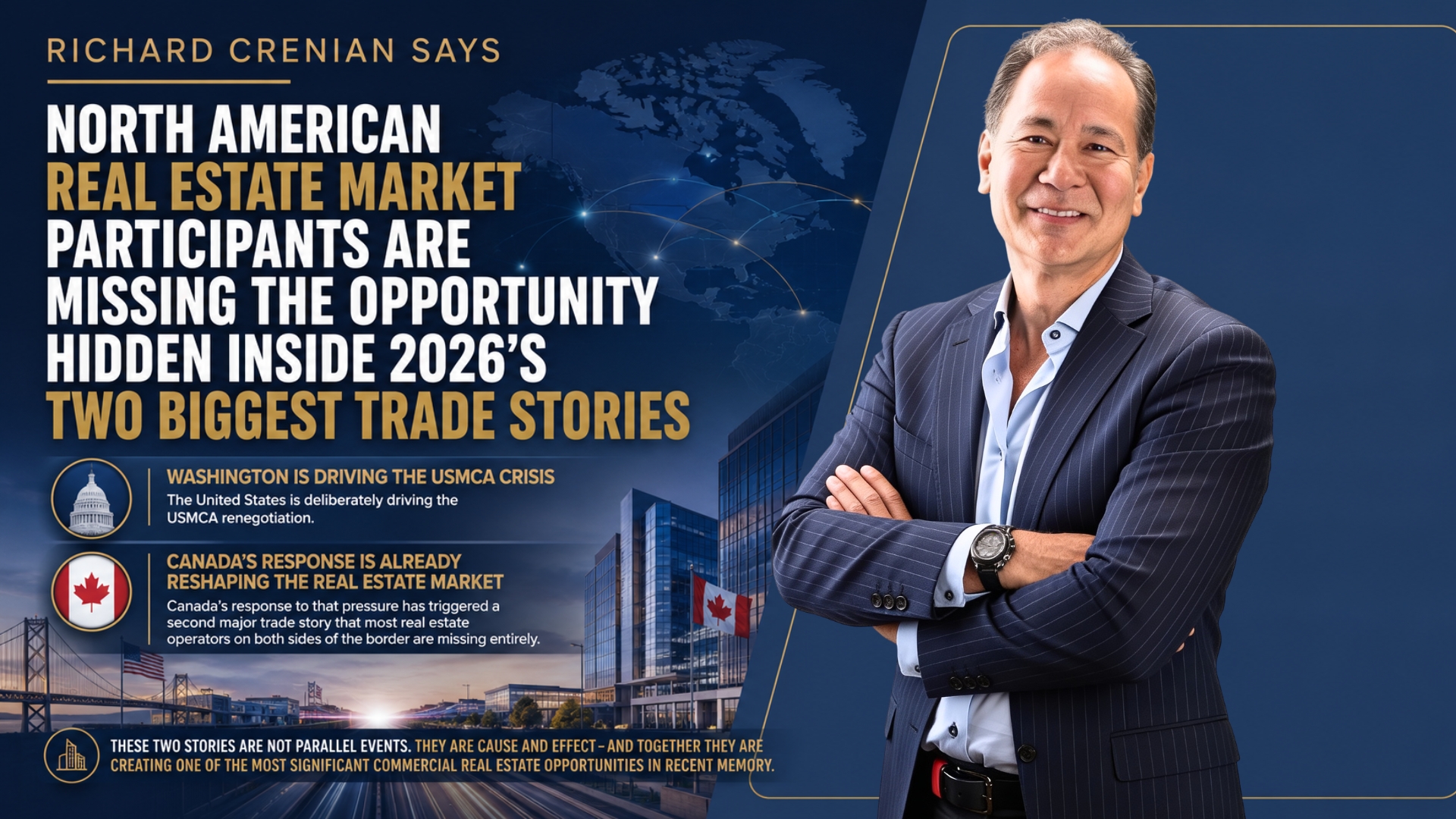
Toronto, Ontario May 20, 2026 (Issuewire.com) - Richard Crenian, one of North America’s most experienced accumulators of real estate, says the two biggest trade stories of 2026 are not running in parallel - they are cause and effect. And hidden inside both of them is a commercial real estate opportunity that most market participants, on both sides of the border, have not yet recognized.
The Trump administration is deliberately using the USMCA’s July 1, 2026 renewal deadline as leverage - pressuring Canada on tariffs, defense spending, border security, and its relationship with China. Canada’s direct response was Prime Minister Carney’s January 2026 deal with Beijing: 49,000 Chinese-built electric vehicles entering Canada annually at a sharply reduced 6.1% tariff, down from a prohibitive 100%. U.S. Trade Representative Jamieson Greer called the arrangement “problematic” - confirming it landed exactly as Ottawa intended.
“This is one story, not two,” says Crenian. “The U.S. is squeezing Canada on trade. Canada is pivoting eastward in response. And the physical infrastructure of that pivot - the dealerships, the service centres, the logistics facilities, the retail plazas - is commercial real estate. That is where smart operators need to be paying attention right now.”
BYD, the world’s largest EV manufacturer, has already engaged a Markham, Ontario-based consultancy to identify up to 20 standalone Canadian dealership locations, starting with three sites in the Greater Toronto Area. Chery and Geely-owned brands are building independent retail networks in parallel. Chinese automakers strongly prefer standalone showroom formats - generating high-visibility commercial real estate demand in exactly the secondary and mid-market locations where Crenian has operated for decades. Downstream demand includes service centres, parts logistics, charging infrastructure, and surrounding mixed-use retail plazas.
Meanwhile, USMCA uncertainty is already rotating capital into domestic hard assets. Companies with cross-border supply chains are pausing long-term commitments. Groups reassessing North American exposure are moving toward stable, income-producing Canadian real estate - a pattern Crenian says he has watched play out in every major uncertainty cycle of his career.
“Every time cross-border confidence wavers, capital looks for somewhere stable to land. Canadian income-producing real estate has historically been that destination. What I’m watching right now is the same rotation - at a scale I haven’t seen before. The people who benefit most are the ones already in position, not the ones waiting for the headlines to resolve.”
With Canada’s first-ever Investment Summit scheduled for September 2026 in Toronto and $97 billion in foreign investment commitments secured in the past year, Crenian argues the fundamentals for Canadian commercial real estate have rarely been stronger - precisely at the moment when uncertainty is keeping most market participants on the sidelines.
About Richard Crenian
Richard Crenian is curious; he is an experienced thought leader, and has lived a full and experienced life. He is an entrepreneur, a businessman, sportsman, philanthropist, investor and a builder and accumulator of real estate.
Media Contact
Jessica Murphy *****@redevgroup.ca 77 Bloor St. W, Toronto, ON M5S 1M2 http://Richardcrenian.com