Brandon, Mississippi Aug 4, 2026 (Issuewire.com) - The American dream has long been built around the promise of owning a home. A home represents security, stability, belonging, and the opportunity to build wealth for future generations. Yet behind every front door is a larger story, shaped by laws, financial systems, professional practices, and institutional decisions that influence who gains access to opportunity and who faces barriers along the way.
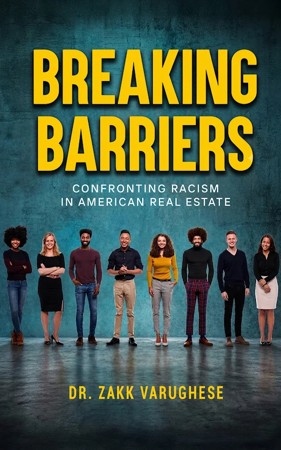
In his newly released book, Breaking Barriers: Confronting Racism in American Real Estate, Dr. Zakk Varughese examines the history and evolution of housing inequality in America, revealing how systems that once openly excluded communities have transformed into more subtle and complex forms that continue to shape the modern housing market.
A real estate broker, educator, and advocate, Dr. Varughese brings an insider’s perspective to one of the nation’s most important conversations: how housing determines opportunity. Through historical research, legal analysis, housing scholarship, public reporting, and professional observation, Breaking Barriers explores how housing inequality was constructed through policy, finance, land use, and industry practices, and how those influences continue today.
“Understanding housing requires looking beyond individual transactions,” said Dr. Varughese in a recent interview. “The housing market is shaped by systems that determine who can access opportunity, who can build wealth, who can remain in their communities, and who is forced to overcome additional barriers.”
At the center of Breaking Barriers is Dr. Varughese’s Six Dimensions of Housing Opportunity, a framework that explains how housing access is shaped by interconnected forces:
• Legal Access — the laws, regulations, and protections that determine property rights and housing opportunity.
• Financial Access — the role of mortgages, credit, insurance, appraisals, and wealth resources in achieving sustainable homeownership.
• Professional Access — the influence of real estate professionals, lenders, appraisers, and industry networks in shaping housing outcomes.
• Geographic Access — how location affects access to schools, employment, transportation, healthcare, and community investment.
• Institutional Access — how organizations, regulations, and decision-making structures influence housing systems.
• Environmental Access — the ability of families to remain safely housed as communities face changing economic and environmental pressures.
The book traces the historical foundations of housing inequality, including redlining, restrictive covenants, discriminatory lending practices, exclusionary zoning, and urban renewal, while examining the modern challenges reshaping housing today. These include artificial intelligence in lending and valuation, appraisal disparities, institutional investment in housing, affordability pressures, and the changing role of technology in determining access.
Through compelling examples, Breaking Barriers illustrates how exclusion does not always appear as a closed door. Sometimes it appears as fewer choices, limited information, unequal expectations, or decisions made through systems that appear neutral while producing unequal outcomes. The book explores the experiences of qualified buyers and homeowners who encounter barriers not because they lack preparation or ability, but because opportunity itself can be shaped by forces operating behind the scenes.
Rather than focusing only on past injustice, Dr. Varughese challenges readers to consider the future of housing. The book asks critical questions facing America today:
Who gets access to opportunity?
Who builds wealth?
Who benefits from growth?
Who gets to stay?
Breaking Barriers: Confronting Racism in American Real Estate is the first book in the Breaking Barriers Trilogy, a series exploring race, housing, professional responsibility, and the systems that influence real estate opportunity in America.
The book is now available on Amazon for real estate professionals, educators, policymakers, housing advocates, students, and readers seeking a deeper understanding of how housing shapes economic opportunity, community development, and the American experience. For more information about the author and his book, visit their website.
About the Author
Dr. Zakk Varughese is a real estate broker, educator, speaker, and advocate whose work brings housing, leadership, and public service into the same conversation. As founder of HomesRX, he writes from direct experience in real estate while drawing on a broader background in education and organizational leadership.
He holds a Doctor of Education degree and has served as a college professor, with a focus on practical instruction, ethics, communication, and the human consequences of institutional systems. Across his professional work, he has emphasized consumer advocacy, fair access, and honest public discussion about how policy shapes everyday life.
In Breaking Barriers, Dr. Varughese combines frontline industry knowledge with public-facing education to press for a more accountable and more equitable housing culture.
This book is part of the broader Breaking Barriers project. Read alongside Breaking Barriers: Stories from a Black Real Estate Broker in the Deep South, it serves as the historical and policy foundation for the lived experiences explored in the companion narrative. Finally, The Toolkit for Fair Housing and Repair translates these insights into action, delivering practical tools and ethical guides for industry change. Together, the trilogy demonstrates that housing inequality was a deliberately constructed machine, moving readers from historical awareness to active, modern-day market transformation.
Media Contact
BMD Digital INC. *****@bmddigital.com https://www.bmddigital.com/