
Zhenjiang, Jiangsu Aug 2, 2026 (Issuewire.com) - The global eyewear market is experiencing a significant shift as consumers increasingly demand personalized vision correction solutions. For optical chains, independent retailers, and vision care networks, the ability to source high-quality Custom Prescription Optical Lenses has become a valuable asset. Navigating the global supply chain to find a reliable prescription (RX) manufacturing partner requires a strategic understanding of optical technology, production capacity, and quality control systems.
This sourcing guide outlines the essential steps and technical benchmarks that retail buyers must evaluate to secure a stable supply of premium custom lenses that meet modern ophthalmic standards.
Step 1: Evaluating Advanced Manufacturing Infrastructure and Technological Heritage
When sourcing custom prescription lenses, the foundational criterion for any retail chain is the manufacturer’s technological infrastructure. The prescription lens market relies heavily on the precision of digital surfacing. A laboratory's heritage and investment profile often dictate its capability to deliver consistent results.
For instance, facilities that leverage international technical partnerships—such as joint ventures combining South Korean optical engineering with German precision machinery—demonstrate a higher baseline of operational reliability. Retail buyers should look for manufacturers equipped with industry-standard automated systems, such as the VFT-Orbit full-automatic RX equipment from Germany's LOH. This machinery allows for the precise fabrication of complex geometries required for modern corrective lenses.
Furthermore, production scale is critical for securing supply chain stability for large optical chains. A facility supported by the company’s broader resin lens production capacity of up to 50,000 pairs daily, combined with advanced vacuum coating machinery like NVC equipment, ensures that high-volume orders can be processed without compromising lead times. A well-structured inventory and modern storage systems are also crucial, allowing partners to maintain a comprehensive stock of semi-finished blanks across all refractive indices, which directly translates to faster turnaround times for the end consumer.
Step 2: RX Order Technical Verification & Tolerance Benchmarks
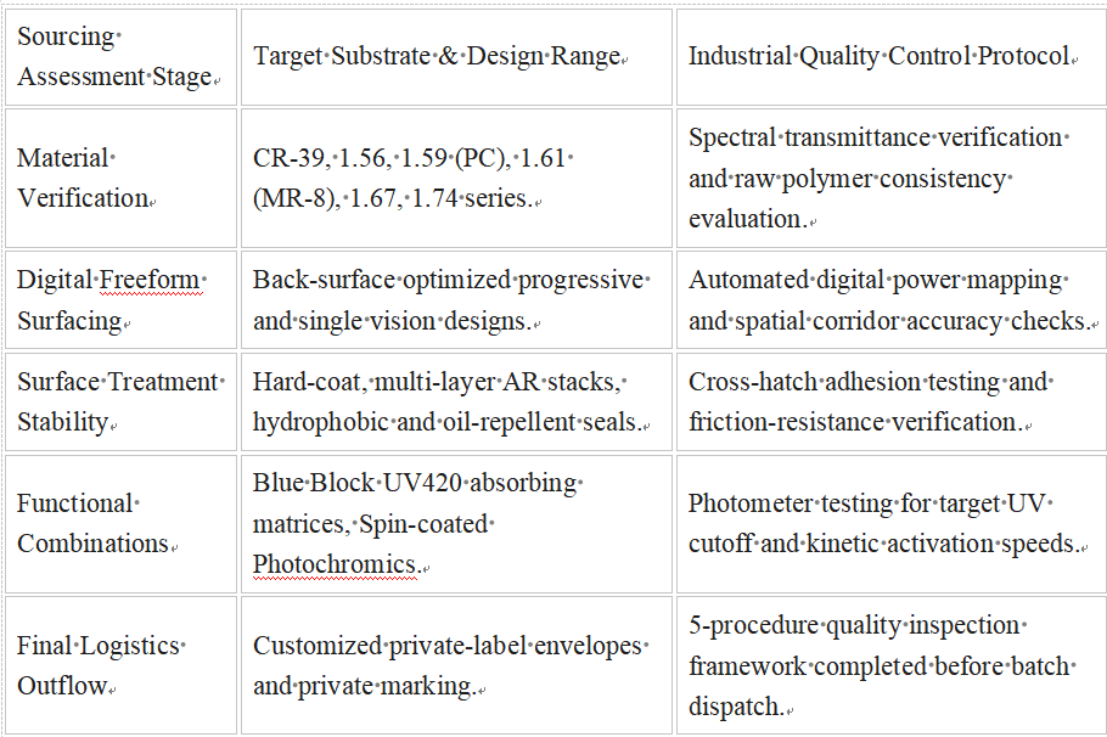
To minimize laboratory rejection rates and guarantee seamless edging at retail shops, procurement managers should benchmark suppliers against clear operational frameworks. Below is the technical compliance structure utilized within our prescription manufacturing line:
By consolidating sourcing with a manufacturer like CONVOX, which handles the entire matrix of indices from 1.50 to 1.74, optical retailers can streamline their procurement processes, ensure consistent tinting and coating performance across different materials, and reduce logistical complexities.
Step 3: Assessing Digital Freeform Surface Design and Customization Capabilities
Traditional cast lenses are rapidly being replaced by digitally surfaced alternatives due to the enhanced visual acuity they offer. The primary utility of a modern custom lens lies in its design geometry, particularly in Freeform Progressive and specialized functional designs.
Unlike traditional progressives that feature a fixed molded design on the front surface, digital freeform technology applies the prescription design to the back surface of the lens using three-axis CNC generators. This approach shortens the distance between the eye and the corrective surface, expanding the effective field of view and significantly minimizing the swim effect and lateral peripheral distortions.
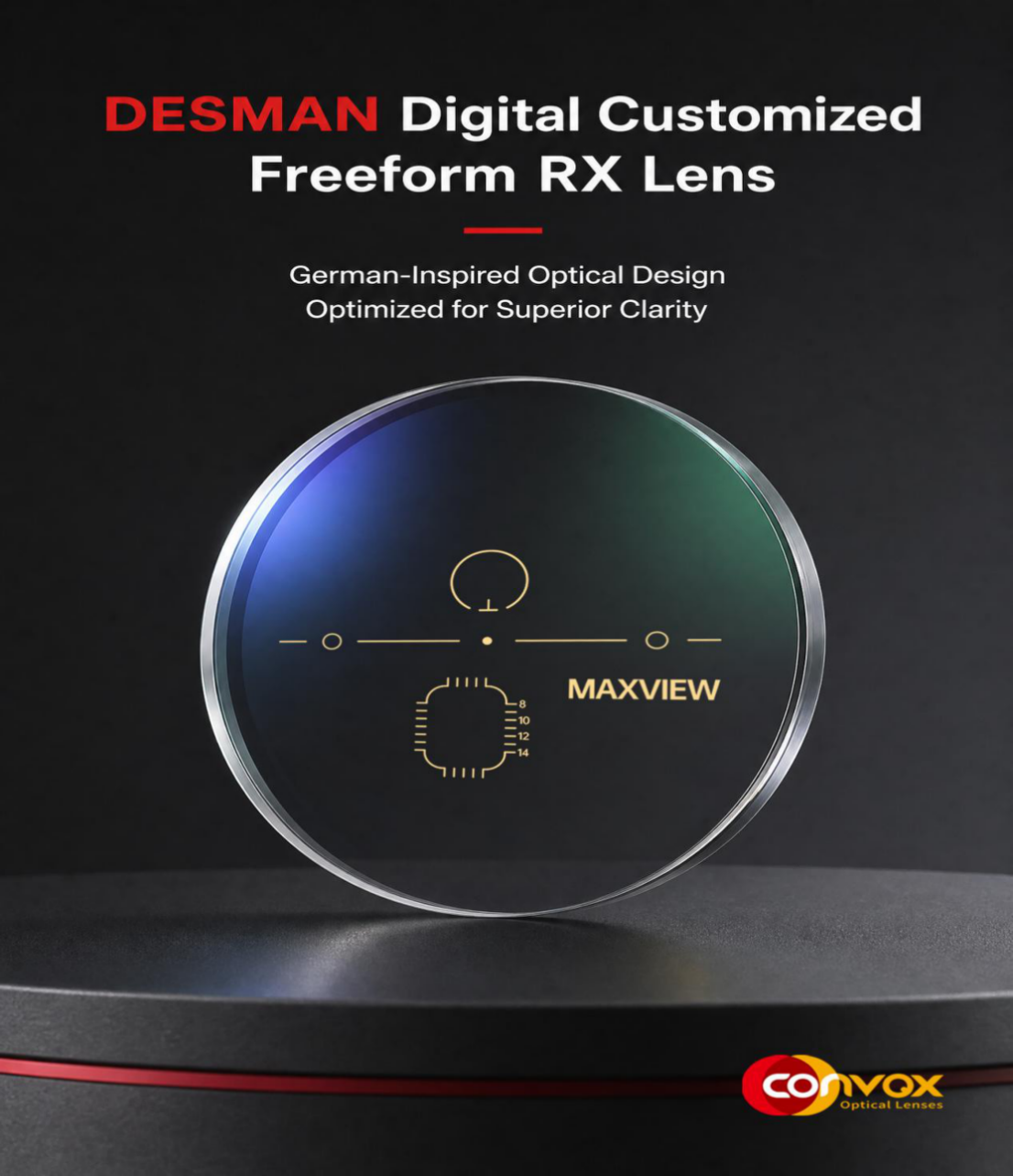
A prime example of technical innovation in this category is the CONVOX Surfaced Freeform RX Lens, which utilizes advanced mathematical algorithms to calculate point-by-point surface corrections. This technical precision allows for the successful fabrication of highly customized products, including:
- Freeform Progressive Lenses:Tailored corridors and soft transitions between distance, intermediate, and near vision zones, customized to the wearer's specific frame choice and wrap angle.
- Photochromic Spin-Coating Lenses:Integrating advanced photochromic matrices via spin-coating rather than in-mass mixing, ensuring rapid activation and fading times along with perfectly uniform color distribution across high-minus or high-plus prescription profiles.
- Myopia Control Defocus Lenses:Utilizing specialized lens designs tailored for selected markets to assist in pediatric visual management, subject to local regulatory requirements.
Retailers must ensure that their RX source can seamlessly integrate these advanced designs into daily production schedules, delivering consistent optical performance across all custom orders.
Step 4: Analysing Treatment Technologies and Functional Enhancements
The longevity and performance of a custom prescription lens depend heavily on its surface treatments. A bare resin lens is highly susceptible to scratching and environmental degradation. Therefore, a premium sourcing partner must possess advanced automated coating lines capable of applying multi-layer stacks that enhance visual performance and durability. Buyers should look for the following specialized lens treatments during their evaluation:
- Anti-Reflective (AR) and Ultra-Clean Top Coats: Multi-layer vacuum-deposited AR coatings increase light transmission through the lens, eliminating distracting reflections. The addition of a durable hydrophobic and oil-repellent (SHV) top coat reduces surface energy, making the lens resistant to water droplets, facial oils, and smudges.
- Blue Block Technology: Retailers should distinguish between surface-coated filters and material-absorptive technologies. Substrates that incorporate blue-light-absorbing monomers directly into the resin monomer provide durable protection against high-energy visible (HEV) blue light without intense purple residual reflections.
- Specialized Functional Treatments: Options such as anti-fog layers, high-contrast polarization filters, and light-adaptive transitions add value to a retailer's premium product tiers, driving consumer satisfaction at the dispensing counter.
Step 5: Implementing Rigorous Quality Assurance and Supply Chain Verification
The final step in establishing a trusted RX sourcing relationship is verifying the manufacturer's quality assurance framework. Unlike stock lenses, custom prescription lenses are made to order, meaning any manufacturing error results in a total loss of material and delayed patient delivery.
A reliable OEM/ODM partner must implement strict tolerances that align with international standards, such as ISO9001 and ISO13485. Every customized lens must undergo rigorous testing throughout the production cycle, including computerized lensometry verification for sphere, cylinder, axis, and prism power, cross-hatch adhesion testing for coating durability, and automated cosmetic inspection for surface inclusions or chips.
Furthermore, operational transparency is essential. CONVOX provides clear communication channels, maintaining a modern storage system with sufficient ready stock to fulfill specialized prescription requirements within a standard 48–72 hour operational window, depending on prescription complexity and coating requirements. By partnering with a vertically integrated manufacturer that controls the process from monomer preparation to digital surfacing and advanced coating, optical chains can minimize errors, stabilize operational costs, and deliver superior visual experiences to patients worldwide.
For more information regarding advanced prescription lens manufacturing and global OEM services, please visit the official corporate portal at https://www.convox-optical.com/
Step 6: FAQ: Sourcing Management for Retail Chains
Q1: How does CONVOX guarantee diopter power accuracy on complex freeform progressive orders?
A1: Every single digital freeform lens is passed through a comprehensive 5-procedure quality inspection framework. This includes mapping the back-surface topography via computerized lensometry systems to verify the exact sphere, cylinder, axis, and progressive corridor length prior to packaging.
Q2: Can we choose custom laser-engraving markings for our retail chain's private brand?
A2: Yes. As part of our comprehensive B2B OEM/ODM integration, we can incorporate specific, semi-visible laser markings onto the lenses according to your brand's alignment specifications, aiding in layout identification and private-label authentication.
Q3: What is the estimated turnaround time for overseas custom RX delivery?
A3: Our automated prescription division completes the fabrication, coating, and testing of custom scripts within a 48–72 hour window, depending on complexity. Sourcing timelines are further optimized by our extensive ready stock of semi-finished blanks across all indices, minimizing baseline processing delays.
Q4: How durable are the anti-reflective and hydrophobic coatings against everyday cleaning?
A4: Our vacuum-deposited multi-layer coatings are engineered with specialized hard-coat adhesion layers. All batches undergo strict cross-hatch testing and environmental simulation, ensuring the hydrophobic, anti-glare, and oil-repellent layers remain securely bonded under typical daily usage conditions.
Corporate Website: [https://www.convox-optical.com/]
Contact Email: sales@convox.cn
Contact Our Export Office Today:
Are you managing procurement for an optical chain or retail network? Contact our sales representatives today to receive our standard Rx processing guide, request product samples for laboratory evaluation, or obtain a wholesale quotation for custom OEM packaging solutions.
Media Contact
JIANGSU CONVOX OPTICAL CO.,LTD. sales@convox.cn