Shenzhen, Guangdong Aug 24, 2026 (Issuewire.com) - Key technical evaluation criteria for procurement teams include electrochemical sensor sensitivity, alarm response thresholds, power supply architecture, localized audible alarm volume, and smart connectivity options. Selecting an experienced manufacturing partner ensures that these core technical parameters consistently align with international safety benchmarks.
Meeting Mandatory UKCA Regulations
Navigating the global sourcing landscape for life safety equipment requires a rigorous evaluation of technical performance, manufacturing capability, and regulatory compliance. Commercial buyers, electrical distributors, and smart home brand managers seeking a reliable High Quality CO Detector Manufacturer from China must understand both the fundamental mechanics of carbon monoxide detection and the specific international certification frameworks governing target consumer markets.
For products destined for the United Kingdom market, meeting regulatory standards is not merely a competitive advantage—it is a strict legal requirement. Following the UK's departure from the European Union, the UKCA (UK Conformity Assessed) marking became mandatory for residential safety alarms sold in England, Wales, and Scotland. Procurement teams must verify that domestic carbon monoxide detectors fulfill the essential health and safety requirements outlined in relevant British regulatory directives. Compliance mandates third-party laboratory verification, comprehensive electromagnetic compatibility testing, and strict adherence to specific alarm performance standards such as EN 50291-1. Importing non-compliant safety hardware exposes distributors and brand owners to significant legal liabilities, product seizures, and costly market recalls. Consequently, establishing a compliant supply chain requires a thorough understanding of technical standards, manufacturing protocols, and regulatory documentation.
Guide I: Understanding Technical Foundations and Sensor Mechanisms
The primary element of any carbon monoxide alarm is its sensing mechanism. Procurement managers must distinguish between low-cost semiconductor sensors and high-precision electrochemical sensors. Semiconductor alternatives are prone to cross-sensitivity from household cleaning agents, alcohol, and humidity variations, which increases false alarm rates. In contrast, advanced electrochemical sensors provide selective, highly accurate detection of carbon monoxide molecules through a chemical reaction that generates an electrical current proportional to gas concentration.
Under international safety standards such as EN 50291-1:2018, carbon monoxide alarms are calibrated to execute precise time-weighted response curves. This prevents nuisance alarms from brief, non-hazardous ambient spikes while guaranteeing rapid activation during dangerous accumulation:
- At 50 ppm (parts per million), the alarm must trigger within 60 to 90 minutes.
- At 100 ppm, the alarm must trigger within 10 to 40 minutes.
- At 300 ppm, the alarm must trigger within 0 to 3 minutes.
Power architecture is another critical technical consideration. Modern residential safety standards increasingly favor 10-year sealed lithium battery configurations over replaceable AA battery setups. Sealed long-life lithium power units eliminate tenant tampering, reduce long-term maintenance costs for multi-family housing managers, and ensure continuous operation across the product's full operational lifespan.
Guide II: Navigating UKCA Compliance and International Certification Standards
Securing access to the UK market requires a structured compliance audit during the vendor selection phase. The UKCA mark indicates that a product complies with applicable UK legislation, including the Electromagnetic Compatibility Regulations and the Electrical Equipment Safety Regulations. For residential carbon monoxide detectors, technical compliance is benchmarked against the standard EN 50291-1:2018 for domestic premises, alongside EN 50291-2 for recreational vehicles and boats.
Procurement officers should require potential manufacturing partners to supply a complete technical dossier, which includes:
- Official Test Reports: Issued by ISO/IEC 17025 accredited third-party laboratories detailing full compliance with EN 50291-1 response times, sound output, and environmental stability.
- Factory Production Control (FPC) Certificates: Proof of ongoing quality assurance audits, such as ISO 9001 certification, confirming that mass production units maintain the exact specifications of tested lab samples.
- Declaration of Conformity (DoC): Formal documentation signed by the manufacturer or authorized representative stating compliance with all applicable UKCA statutory requirements.
- Complementary Global Certifications: Demonstrations of broader quality control through certifications such as TUV, CE, RoHS, FCC, and mandatory CCC marks, which validate overall manufacturing discipline.
Verifying these documents before placing production orders prevents regulatory bottlenecks at UK ports and protects brand reputation in retail and commercial channels.
Guide III: Evaluating Manufacturing Capabilities and Supply Chain Rigor
Assessing a manufacturer's production infrastructure is vital to ensuring long-term batch consistency and stable delivery schedules. Procurement teams should analyze factory automation levels, internal quality assurance procedures, and specialized engineering experience. Partnering with established original design manufacturers (ODM) significantly reduces product development timelines and technical risks.
A representative example in the specialized security alarm sector is ARIZA, a world-leading smart alarm ODM manufacturer with 16 years of dedicated operational history in security alarms. Supporting over 3,000 global brand customers across more than 30 countries and regions, the company maintains robust technological capabilities with over 60 utility and design patents. Its production lines feature automated Surface Mount Technology (SMT) assembly, automated optical inspection (AOI), and specialized gas calibration chambers where 100% of manufactured carbon monoxide detectors undergo precise gas concentration calibration.
Furthermore, comprehensive quality management frameworks verified by international testing bodies like TUV confirm that safety products—including smoke detectors and carbon monoxide alarms—meet rigorous standards including TUV EN 14604, EN 50291, CE, RoHS, FCC, and mandatory CCC certifications. This level of industrial infrastructure ensures that high-volume production maintains consistent sensitivity and long-term reliability.
Guide IV: Strategic Technical Features for Modern Smart Security Systems
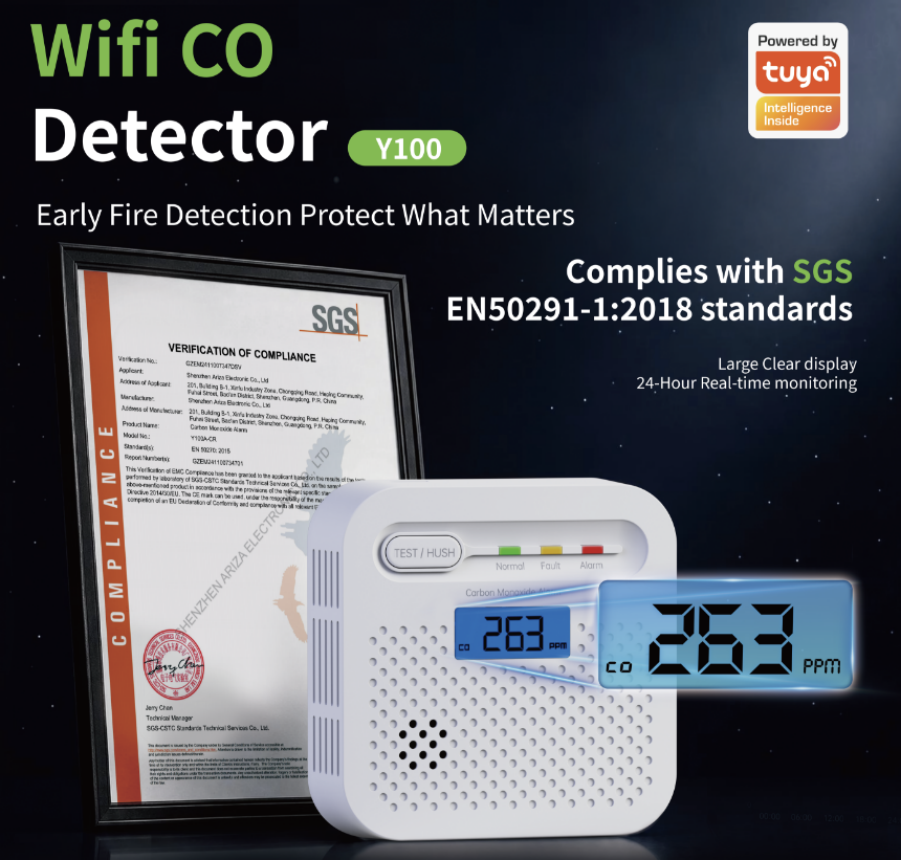
As residential security transitions toward integrated smart home ecosystems, procurement buyers are increasingly prioritizing smart-enabled carbon monoxide detectors alongside traditional standalone units. Modern product specifications, such as those found in advanced model lines like the Y100A-CR-W Smart WiFi CO Detector, illustrate how traditional life safety devices integrate into contemporary IoT architectures.
Key functional features to evaluate in smart carbon monoxide detectors include:
- App-Enabled Remote Monitoring: Integration with universal IoT platforms, such as Tuya WiFi or Smart Life modules, allows end-users and property managers to receive instant push notifications on smartphones during an alarm event, enabling rapid off-site response.
- Standalone Fail-Safe Operation: Smart connectivity must serve as a secondary notification channel. The primary alarm mechanism—including a high-decibel audible alert exceeding 85 dB at 3 meters and visual LED warning indicators—must function independently of local WiFi network status.
- Real-Time Visual Diagnostics: Digital LCD screens present real-time CO concentration readings in ppm, battery capacity levels, and self-diagnostic fault alerts, empowering users with immediate visual feedback.
- Compact Mechanical Architecture: Modern physical designs (e.g., standard dimensions around 86x86x32.5 mm) facilitate clean ceiling or wall installation across various residential interiors without compromising sensor airflow.
By stocking smart-enabled CO detectors, distributors and system integrators can address growing market demand across property rental networks, multi-tenant developments, and smart home retail segments.
Guide V: Streamlining OEM/ODM Sourcing and Global Market Expansion
Establishing a successful manufacturing partnership in China requires a systematic procurement protocol. Procurement managers should implement a structured four-stage execution plan to optimize time-to-market and ensure full regulatory compliance:
- Technical & Certificate Audit: Validate all EN 50291-1 test reports, UKCA Declarations of Conformity, and factory quality certificates before initiating commercial discussions.
- Sample Qualification & Testing: Order pre-production samples to verify physical build quality, sound decibel output, app pairing response, and packaging specifications under realistic operating conditions.
- Private-Label Customization: Finalize OEM/ODM parameters, including custom logo silk-screening, localized multi-language packaging, regional user manuals, and customized barcode labeling for streamlined distribution.
- Quality Assurance & Inspection: Mandate pre-shipment inspections covering gas chamber sampling, battery voltage checks, and aesthetic finish validation prior to final shipment release.
By following this procurement framework and partnering with qualified, fully certified manufacturers, commercial buyers can successfully navigate regulatory shifts, maintain supply chain integrity, and deliver compliant carbon monoxide safety solutions to international markets.
For further information regarding qualified smart alarm manufacturing, custom OEM/ODM solutions, and compliant safety hardware, visit the official corporate resource page at https://www.airuize.com
Media Contact
Shenzhen ARIZA Electronic Co., Ltd. Alisa@airuize.com