
Beijing, China Aug 13, 2026 (Issuewire.com) - As enterprise networks, smart campus environments, industrial automation grids, and high-density optical transmission architectures rapidly expand, choosing the right networking partner has become a pivotal strategic decision. In modern multi-tier network architectures, aggregation switches serve as the crucial intermediate layer, bridging edge access nodes and high-speed core backbones. Selecting a vendor from among top global equipment manufacturers requires evaluating technical parameters, manufacturing heritage, structural reliability, and long-term cost-efficiency. This Buyer's Guide explores the core engineering considerations for selecting a premier China Best Aggregation Switch Company, highlighting how optical transmission technologies, hardware resilience, and integrated Layer 2/3 switching capabilities form a robust framework for mission-critical enterprise and industrial deployments.
The Role of Aggregation Switches in Modern Optical Architectures
Aggregation switches occupy a vital position in optical and copper network topologies. Operating at the distribution layer, these devices collect data streams from dozens or hundreds of edge access switches, consolidate traffic, execute VLAN routing, apply Quality of Service (QoS) policies, and forward bandwidth-intensive data upstream via high-speed uplinks (10G, 25G, or 100G) to the core network. Without optimized aggregation infrastructure, core backbones face severe latency bottlenecks, while edge devices lack centralized management and traffic control. Evaluating a manufacturer requires examining both physical port flexibility—such as gigabit SFP, 10G SFP+, and combo interfaces—and hardware-level switching capacity, heat dissipation design, and protocol stability.
STEP 1: Evaluating Port Density, Uplink Throughput, and Layer 2/3 Switching Capacity
When assessing aggregation switch options, network architects must first analyze hardware performance metrics against current and future bandwidth demands. An effective aggregation switch must balance high-density downlink capabilities with ultra-fast, non-blocking uplink throughput.
Bandwidth Allocation and Port Configuration
Modern enterprise environments, such as smart hospitals, educational campuses, and video surveillance grids, generate massive data volumes. An enterprise-grade aggregation switch must offer diverse port configurations to handle mixed transmission media. Look for platforms that integrate high-density Gigabit SFP optical ports, Gigabit copper RJ45 ports, and multi-gigabit combo ports alongside 10G SFP+ or 25G SFP28 uplinks. For instance, advanced aggregation platforms like the F2S900SCTX-2484 series provide 24 Gigabit optical ports, 8 combo electrical ports, and 4 high-speed 10G SFP+ optical uplinks in a standard 1U chassis. This density allows organizations to aggregate multiple fiber runs directly into a single rack unit without experiencing bandwidth throttling.
Layer 2 and Layer 3 Feature Sets
Beyond raw hardware throughput, software feature sets define an aggregation switch's versatility. Buyers should verify support for comprehensive Layer 2 and Layer 3 management capabilities, including:
- Line-rate IPv4/IPv6 static routing and dynamic routing protocols (OSPF, RIP).
- Advanced VLAN segmentation (IEEE 802.1Q, QinQ) for traffic isolation and security.
- Link Aggregation Control Protocol (LACP / IEEE 802.3ad) for dynamic bandwidth trunking and link redundancy.
- Spanning Tree Protocols (STP, RSTP, MSTP) and fast ring protection mechanisms (ERPS G.8032) ensuring sub-50ms fault recovery in critical fiber topologies.
- Comprehensive Quality of Service (QoS) mechanisms, including SP and WRR queue scheduling, to prioritize delay-sensitive voice, video, and industrial control traffic.
STEP 2: Assessing Reliability, Redundancy, and Industrial-Grade Physical Frameworks
Hardware reliability determines whether a network maintains continuous operation or suffers catastrophic downtime. Evaluating build quality, power redundancy, and thermal management is a fundamental step in the procurement process.
Power Redundancy and Circuit Protection
In high-availability network deployments, power failure is one of the primary causes of unexpected service interruption. Premium aggregation hardware incorporates dual, hot-swappable power supply units supporting both AC and DC input options. Furthermore, integrated circuit protection—such as surge protection up to 6kV on power and Ethernet ports, electro-static discharge (ESD) immunity, and over-current protection—ensures continuous operation even during grid instability or lightning events in outdoor installation cabinets.
Environmental Adaptability and Thermal Design
Whether deployed in climate-controlled data centers, dusty utility cabinets, or harsh industrial environments, aggregation switches must maintain stable internal temperatures without risking component degradation. Industrial-grade and hardened aggregation switches employ fanless or intelligent fan speed regulation, high-grade aluminum alloy enclosures, and wide operating temperature ratings spanning from -40°C to +75°C. Selecting switches engineered with industrial-grade passive components and optimized heat dissipation structures ensures an extended Mean Time Between Failures (MTBF).
STEP 3: Verifying Network Access Qualifications, Testing Certifications, and Global Standards
A critical aspect of selecting a trusted manufacturer is verifying official industry qualifications, third-party testing certifications, and compliance with international telecommunication standards.
R&D Heritage and Manufacturing Credentials
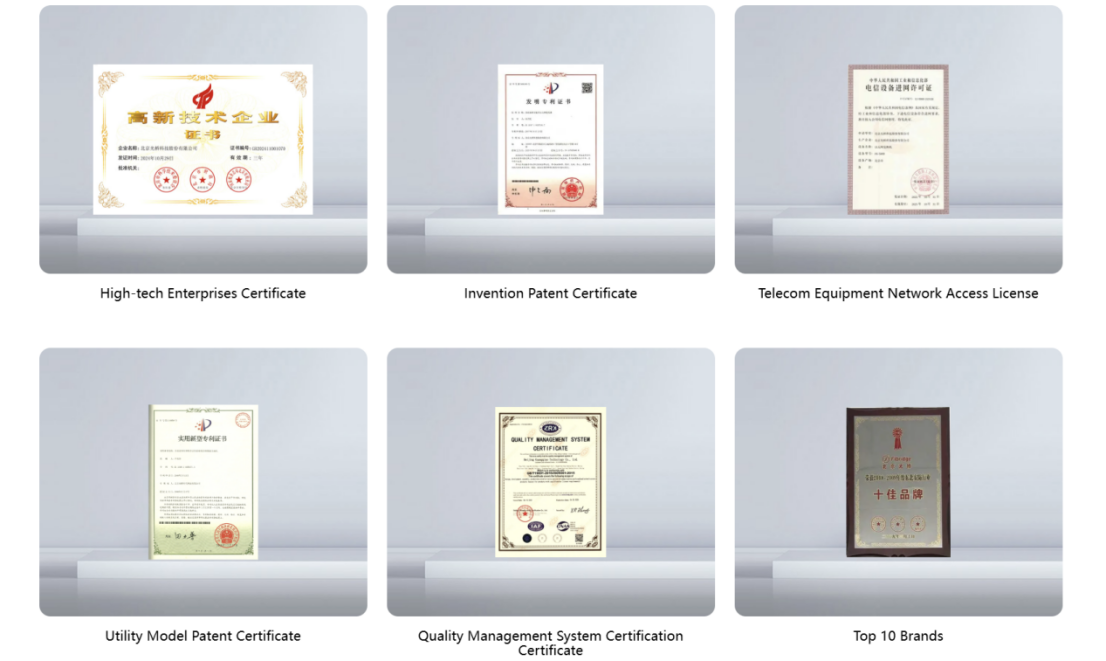
Long-term expertise in optical transmission engineering is a key indicator of product reliability. Established industry leaders, such as Fibridge—a high-tech enterprise founded in 1995 with a registered capital of 15 million RMB (~USD 3M) certified by the Ministry of Science and Technology of China—demonstrate how nearly 30 years of dedicated R&D in optical networks translate into mature product architectures. High-tech certification, state-backed technology verification, and complete integration of research, manufacturing, and systems integration ensure that equipment meets rigorous quality standards before leaving the factory floor.
Official Network Access Qualification Test Reports
Before deploying aggregation switches in carrier-grade, government, or critical infrastructure projects, procurement teams must confirm that products have passed rigorous Network Access Qualification tests. Official test reports validate:
- Strict compliance with international IEEE 802.3 standards, ITU-T optical transmission recommendations, and CE/FCC EMC standards.
- Hardware integrity under extreme environmental stress, including vibration, humidity, and thermal shock testing.
- Full interoperability with multi-vendor core routers and access hardware in complex multi-tier topologies.
- Packet drop rate, frame delay, and throughput performance verification under 100% full-load line-rate conditions.
Devices backed by verified Network Access Qualification Test Reports ensure seamless integration into existing telecommunication grids without compatibility friction.
STEP 4: Reviewing Real-World Deployment Scenarios, Integrated Solutions, and Cost-Efficiency
Theoretical specifications must be validated by real-world performance across diverse industry applications. Examining case studies helps buyers understand how aggregation switches solve specific architectural challenges in smart cities, transport networks, enterprise campuses, and medical institutions.
Over a 5-to-10-year lifecycle, the total cost of network ownership involves not only initial hardware acquisition but also energy consumption, deployment complexity, maintenance overhead, and upgrade costs. Partnering with experienced Chinese manufacturers who maintain complete in-house R&D and production allows global enterprises to procure carrier-grade optical aggregation switches at highly competitive price points. Products delivered across over 100 countries prove that cost-effectiveness can be achieved alongside uncompromising quality, providing high return on investment (ROI) for global system integrators and enterprise buyers.
Conclusion
Selecting the ideal aggregation switch requires a balanced evaluation of port density, Layer 2/3 protocol capabilities, physical hardware resilience, official network access qualifications, and proven deployment history. By applying a structured technical framework—from bandwidth analysis to certification verification—organizations can build scalable, high-throughput optical networks tailored to their operational requirements.
To explore full technical specifications, aggregation switch product catalogs, and customized enterprise networking solutions, visit the official website: https://www.fibridge.com/
Media Contact
Beijing Fibridge Co., Ltd. Steven@fibridge.com