Weifang, Shandong May 7, 2026 (Issuewire.com) - Imagine a busy Monday morning in a high-traffic commercial kitchen or a modern household. As you lift a fully loaded trash bag to take it to the bin, the bottom gives way under the weight of saturated food waste and sharp discarded remains. The resulting mess is not just a cleaning nuisance but a hygiene hazard that can compromise the environment. To prevent such failures, sourcing from a reliable High Quality Leak-Proof Kitchen Trash Bags Exporter from China has become a strategic priority for global distributors and facility managers who demand consistency and durability.
The evolution of waste management solutions has moved beyond simple containment. Today, the focus is on material integrity and rigorous performance standards that ensure a bag can withstand the diverse stresses of kitchen environments. Professional-grade trash liners must balance flexibility with puncture resistance, ensuring that whether the waste is liquid-heavy or contains sharp edges, the integrity of the barrier remains uncompromised.
1. Material Integrity: Diverse Polymer Engineering vs. Generic Utility Grade
The foundation of any high-performance trash bag lies in its molecular structure. Traditional retail bags often utilize a high percentage of low-grade recycled plastics to reduce costs, which frequently results in "thin spots" or inconsistent density. In contrast, modern industrial solutions focus on a diverse matrix of materials tailored to specific environmental and functional needs.
- For heavy-duty applications, high-density polyethylene (HDPE) provides excellent tensile strength and is highly effective for holding heavy, non-sharp loads. However, when kitchen waste includes sharp bones, broken glass, or rigid plastic packaging, HDPE is prone to "zippering"—a phenomenon where a small puncture quickly turns into a long tear.
- Low-density polyethylene (LDPE), particularly Linear Low-Density Polyethylene (LLDPE), offers superior puncture resistance and "stretch," allowing the material to deform around a sharp object rather than piercing through it.
Beyond traditional polymers, leading manufacturers like WEIFANG TAILIN have expanded their material science to include sustainable alternatives. This includes Green PE (bio-based polyethylene) and Ocean Plastic, which repurpose marine waste into durable liners, as well as Compostable and Biodegradable resins that meet stringent environmental certifications like GRS (Global Recycled Standard). By utilizing advanced multi-layer co-extrusion technology, these composite structures leverage the best of both worlds—strength and sustainability—ensuring that material integrity is maintained without compromising ecological responsibility.
2. Functional Application: Sharp Objects vs. Saturated Waste
Kitchen waste is uniquely challenging because it is rarely uniform. A single bag may contain heavy, wet organic matter alongside sharp, rigid disposables like seafood shells or skewers.
- Saturated Waste Handling: For liquids and "wet" trash, the film must have zero porosity. Even at a molecular level, the plastic must be treated to resist degradation from acidic food waste or fats.
- Sharp Object Resistance: This requires high "dart drop" strength. In technical terms, this is the amount of force required to puncture the film with a weighted dart. Professional-grade liners are engineered to have high tear resistance, ensuring that even if a puncture occurs, the hole does not expand.
This technical innovation is supported by a robust manufacturing infrastructure. Leading exporters have invested heavily in high-speed, automated production lines that maintain strict tolerances. This ensures that every batch produced maintains the same performance characteristics, a necessity for B2B clients who manage large-scale facilities and cannot afford the liability of inconsistent product quality.
3. Structural Design: Star Seals vs. Flat Gusset Seals
However, high-performance materials and automated lines are only half of the equation. To truly master kitchen waste containment, this manufacturing precision must be applied to specific structural architectures that address the physics of weight and pressure. Standard kitchen bags are often rated by gallon capacity, but this is a deceptive metric. A 13-gallon bag might hold the volume, but if it is filled with heavy organic waste—such as melon rinds, coffee grounds, and liquid leftovers—the pressure on the bottom seal is immense.
So, a common point of failure in kitchen waste management is the bottom seal. Traditional flat seals create two weak points at the corners where stress is concentrated. If a bag contains heavy soup residues or wet waste, the pressure pushes directly against these seams.
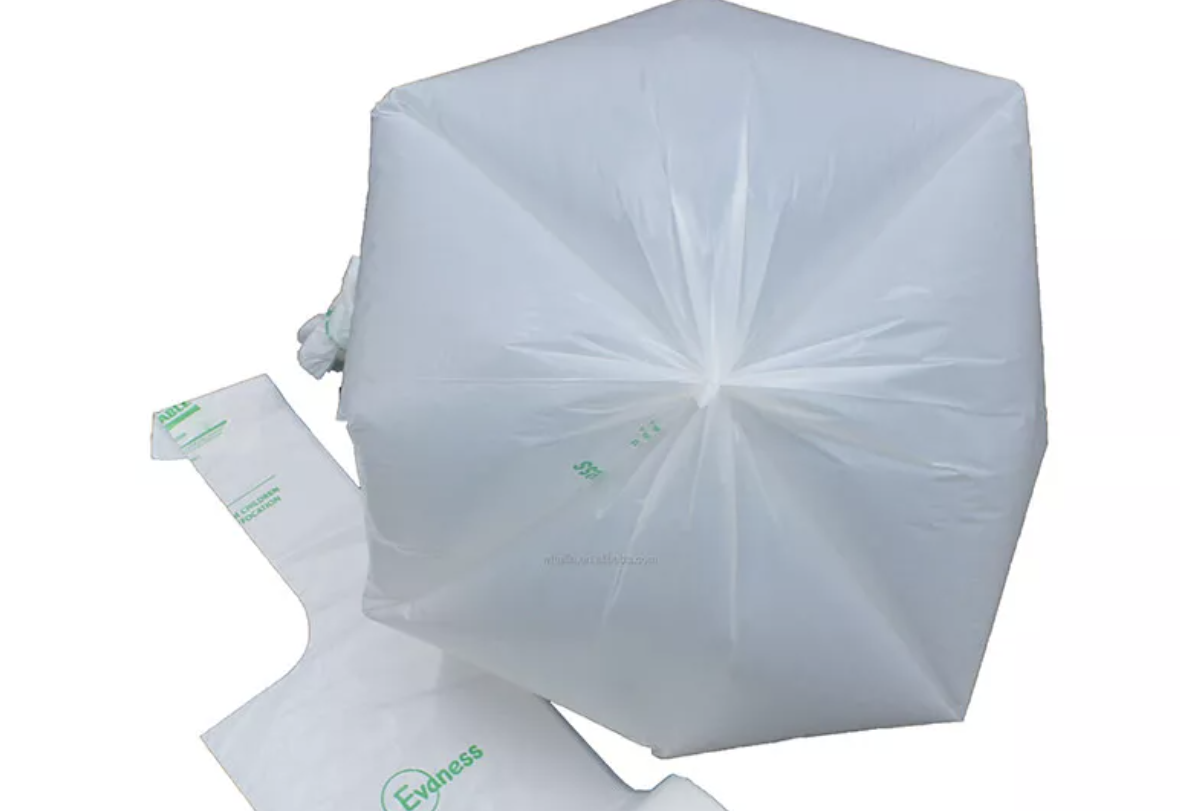
The industry-standard solution for leak prevention is the "Star Seal." By folding the bottom of the bag into a star-like shape and sealing it at a single point, the weight of the trash is distributed across the entire surface area of the seal rather than just the edges. This design significantly reduces the risk of leaks and allows the bag to conform more easily to the shape of the trash can, maximizing usable volume.
For specialized applications, such as drawstring bags, the integration of the closure system into the bag’s architecture is critical. According to technical descriptions of modern Drawstring Bags, the top hem must be reinforced to prevent the drawstring from "pulling through" the plastic when the bag is cinched under a heavy load. This dual focus on the top closure and the bottom seal represents the pinnacle of leak-proof engineering.
Conclusion: The Path Toward Sustainable and Reliable Waste Management
As global awareness of environmental impact grows, the focus on "Material Integrity" also expands to include the lifecycle of the product. High-quality leak-proof bags contribute to sustainability by reducing the need for double-bagging and minimizing the chemical cleaners required to remediate leaks and spills.
Selecting a partner like Weifang Tailin ensures access to a fusion of advanced material science and cost-effective manufacturing. By focusing on the technical parameters of load-bearing, puncture resistance, and seal integrity across a wide range of materials, professional kitchen environments can ensure that their waste management processes are as efficient and hygienic as possible.
For more information on high-performance plastic solutions and technical specifications, visit the official corporate portal: https://www.kangleplastic.cn
Media Contact
WEIFANG TAILIN DOMESTIC PRODUCTS CO.LTD zdn@kangleplastic.cn