Kaifeng, Henan Jul 13, 2026 (Issuewire.com) - The global wedding and event decor market has shifted toward high-quality, reusable decorative solutions. Driving this trend are international event planners and commercial venue operators who seek long-term cost efficiency and uncompromising aesthetic value. As European regulatory frameworks enforce strict compliance protocols for imported commercial decorations, safety documentation has become as vital as design excellence. For international procurement managers, sourcing from a verified China Top Wedding Decorations Exporter involves evaluating both manufacturing capacity and rigorous adherence to regional safety standards. Henan Yongnuo Trading Co., Ltd. (Yongnuo) demonstrates how modern manufacturing frameworks align with European Union compliance guidelines to mitigate import risks while delivering premium design solutions.
Understanding the Role of CE Marking in Commercial Event Decor
The European Union's CE (Conformité Européenne) marking functions as a critical regulatory passport for products entering the European Economic Area. While consumer electronics and medical equipment are widely known to require this compliance, contract textiles, artificial foliage, and large-scale architectural decor elements face equal scrutiny under public safety laws. For structural wedding decorations and simulated plants deployed in high-density public venues, CE compliance focuses primarily on material safety, environmental safety, and chemical limitations.
Regulatory authorities evaluate commercial artificial floral installations across three core safety vectors:
- Flame Retardancy and Thermal Stabilities: Ensuring materials resist ignition and do not accelerate flame spread in enclosed public environments.
- Chemical and Toxicity Restrictions: Strict alignment with REACH (Registration, Evaluation, Authorisation and Restriction of Chemicals) regulations to guarantee the absence of volatile organic compounds (VOCs), heavy metals, or toxic plasticizers.
- Mechanical Integrity and Structural Safety: Verifying that large-scale floral frameworks possess the structural stability to prevent collapse when integrated into commercial arches or overhead trusses.
Non-compliant decorative items pose substantial operational risks for European buyers, ranging from customs seizures at EU ports of entry to severe financial liabilities if local fire marshals condemn a commercial venue’s interior decor. Sourcing from a manufacturer that integrates these parameters directly into the production line is a structural necessity for risk management.
Quality Control Ecosystem Across the Manufacturing Line
Achieving compliance with European safety standards requires transitioning from traditional, workshop-based assembly to an automated, scientifically controlled industrial manufacturing ecosystem. At the production facilities of Yongnuo, this quality control protocol is integrated into every phase of the material lifespan, transforming product safety from a post-production check into an engineering baseline.
Precision Material Selection and Chemical Safety
The production process begins with raw polymer selection. Standard artificial flora often utilizes recycled plastics that contain unverified additives or unstable chemical residues. To ensure compliance with chemical restriction laws, the manufacturing line uses high-grade, virgin polyethylene (PE), polyurethane (PU), and premium silk textiles.
During the compounding stage, specialized flame-retardant additives are integrated directly into the liquid polymer matrix rather than being sprayed onto the finished surface. This molecular integration ensures that the flame-retardant properties remain permanent, resisting degradation from ultraviolet exposure or ambient moisture. Every batch of raw material undergoes baseline spectroscopic analysis to verify that heavy metals—such as lead, cadmium, and mercury—remain completely absent, satisfying the foundational requirements of the European safety framework.
Advanced Automated Injection Molding and Textile Processing
Once the raw materials pass chemical screening, they move to the primary production floor, which spans a 30,000-square-meter modern manufacturing facility. Utilizing 20 automated production lines allows the company to minimize manual handling variations that often introduce structural defects.
The simulated stems, branch networks, and leaf structures are shaped using high-pressure automated injection molding machines. This process ensures precise dimensional uniformity and eliminates internal structural voids that weaken mechanical strength. The fabric elements, representing the floral petals, are processed via precision thermal cutting dies that seal the textile edges automatically. This eliminates fraying and prevents the shedding of loose microfibers, preserving structural integrity during extended commercial reuse and high-density venue deployments.
Engineering Performance: Technical Analysis of Modular Floral Arrangements
To understand how material precision translates into a finished commercial asset, technical procurement officers evaluate the mechanical and chemical specifications of the product architecture. Modular floral installations, designed for high-frequency assembly and disassembly, serve as an ideal case study for assessing structural performance under rigorous operational conditions.
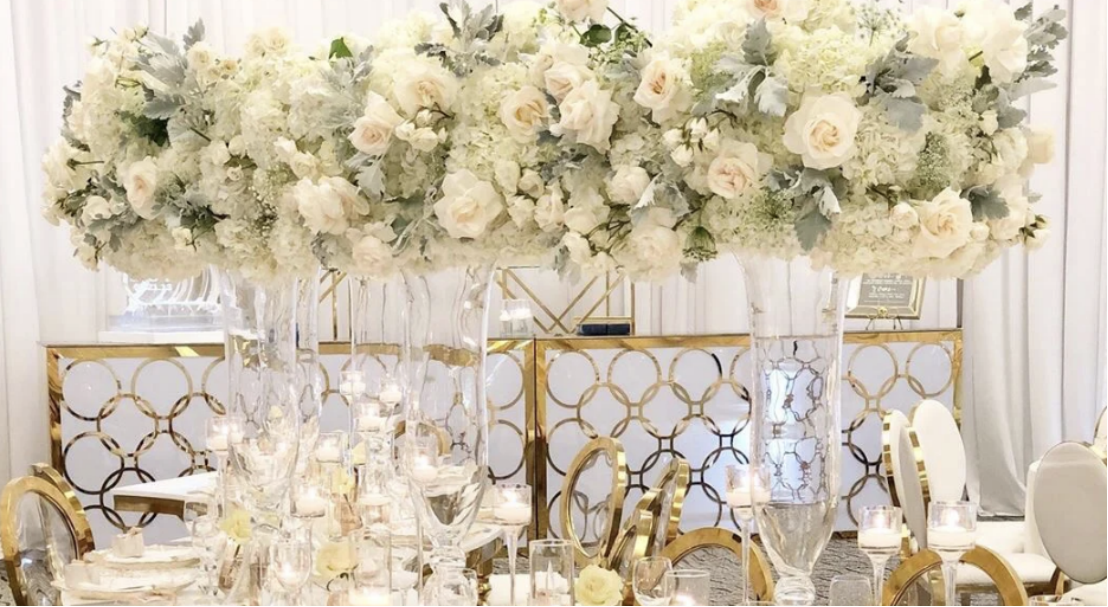
The visual density of the modular arrangement is achieved through a precise layered component architecture. The system integrates specific ratios of simulated botanical varieties to ensure balanced mass distribution and realistic depth:
- Primary Structural Blooms: Premium simulated Hydrangeas and large-petal Peonies form the foundational layer, providing volumetric coverage and acoustic dampening qualities within open banquet halls.
- Secondary Aesthetic Accentuation: High-fidelity silk Roses in multi-toned colorways are mechanically anchored into the base matrix at varying depths to prevent flattening during transport.
- Tertiary Foliage and Stems: Injection-molded eucalyptus branches, structural willow leaves, and flexible vine extensions provide lateral stability and wind resistance for outdoor commercial settings.
The attachment mechanism of each individual bloom utilizes a dual-component thermal bonding process. Stems are inserted into the high-density backing grid under mechanical pressure and fused using industrial-grade hot-melt adhesives. This achieves a pull-out resistance force exceeding 45 Newtons per stem, ensuring that components do not detach during high-wind outdoor deployments or rapid commercial teardowns.
Conclusion
The evolution of the international event decor industry demands a balance between aesthetic innovation and rigorous manufacturing compliance. As European safety standards continue to tighten around commercial installations, the validity of material safety documentation has become an essential component of brand reputation and operational safety. By anchoring production within automated manufacturing protocols, utilizing chemically verified raw materials, and providing complete engineering data, Yongnuo demonstrates that industrial-scale floral production can simultaneously achieve premium visual design and complete alignment with global safety frameworks.
To view complete product specifications, manufacturing certifications, and technical documentation, visit the official corporate portal at https://www.yongnuoflower.com/
Media Contact
Henan Yongnuo Trading Co., Ltd. zhang888bo@gmail.com