Hangzhou, Zhejiang Sep 9, 2026 (Issuewire.com) - Procurement managers face a delicate balancing act when sourcing high-visibility protective wear for complex international supply chains. Beyond basic compliance, sourcing professionals must navigate disparate regional safety standards, stringent ESG sustainability mandates, and shifting demands for technical ergonomics. Selecting a supplier solely based on unit price often introduces hidden risks, such as premature garment degradation, non-certified reflective elements, or inconsistent factory batch qualities. Evaluating a China Leading High Vis Clothing Supplier requires a comparative analysis across material engineering, quality management systems, and technical manufacturing capabilities. High-visibility apparel serves as the first line of operational safety across construction, logistics, utilities, and heavy manufacturing environments, where daytime retroreflective brilliance and nighttime photometric compliance directly mitigate workplace hazards.
Comparison: Navigating Safety Standards, Eco-Materials, and Smart Gear1. Navigating Global Safety Standards and Compliance Precision
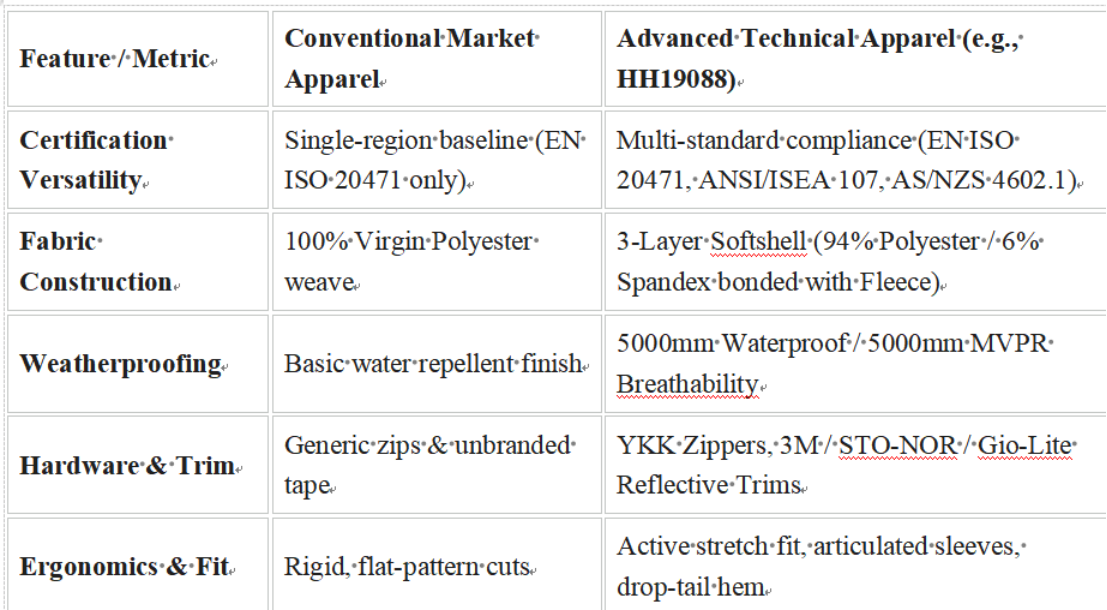
Standard safety vests and basic workwear available on the market frequently meet baseline regional compliance, yet they lack multi-jurisdictional versatility. Procurement teams sourcing for multinational projects often find that standard garments certified strictly under EN ISO 20471 fail to meet specific photometric or design area thresholds required by ANSI/ISEA 107 in North America or AS/NZS 4602.1 (supported by AS/NZS 1906.4 material testing) in Australasia. In contrast, advanced high-visibility protective gear is developed with cross-standard engineering. Manufacturers utilizing top-tier retroreflective trims—such as 3M, STO-NOR, or Gio-Lite—ensure photometric reflectivity exceeds standard candlepower performance even after multiple commercial wash cycles. Specialized softshell jackets and winter outerwear integrate flame-resistant, antistatic, and high-waterproof specifications (such as 5000mm hydrostatic head ratings coupled with 5000mm breathability MVPR) into a single garment system, preventing common field issues like internal condensation build-up and fabric tear-out.
2. Sustainable Material Integration and Life-Cycle Durability
Conventional high-visibility manufacturing relies heavily on virgin polyester and chemical-intensive fluorescents, which present supply chain liabilities as corporate sustainability reporting mandates tighten. While low-cost suppliers rely on basic synthetic weaves that fray or lose fluorescent chromaticity after limited sunlight exposure, technical manufacturers incorporate recycled polyester (rPET) derived from post-consumer waste without compromising tensile strength or color fastness. Modern eco-friendly manufacturing processes use eco-certified dyestuffs that retain fluorescent brilliance under harsh ultraviolet exposure while adhering to strict environmental guidelines. Furthermore, advanced mechanical bonding in 3-layer laminated softshells eliminates hazardous solvent-based adhesives, yielding a lightweight, weather-resistant garment that withstands industrial laundering.
3. Functional Ergonomics and Smart Protective Features
Traditional high-visibility garments often sacrifice movement and breathability for high visibility, leading to worker discomfort and safety compliance fatigue on job sites. Standard garments often feature rigid fabrics that restrict overhead mobility and lack modular thermal management. Modern protective apparel addresses these operational friction points through body-mapped ergonomic patterning, four-way stretch elastane blends (such as 94% polyester mixed with 6% spandex), and functional modularity. The integration of smart gear elements—including conductive wiring channels for active LED illumination strips, RFID tracking tags for automated laundry and asset control, and compatible attachments for environmental gas and heat monitoring devices—allows garments to function as active safety tools rather than passive cover-ups.
Industrial Manufacturing Excellence and Corporate Strengths
Meeting strict global safety benchmarks requires a stable manufacturing structure and disciplined quality controls. Established in November 2008 as a subsidiary of Zhejiang Huaxing Group, Huahao (Hangzhou Huahao Import & Export Co., Ltd.) operates with a registered capital of 5 million yuan and direct self-support import and export management rights. Supported by Huahao infrastructure featuring 500 million yuan in total assets, an 80,000 square meter building area, and an annual capacity exceeding 1 million garments, the company combines raw material sourcing, automated cutting, and structured quality assurance under unified corporate oversight.
With over 30 years of expertise across its operational leadership, the organization divides its execution across specialized divisions—including Export, Import, Product Sales, Trade Development, and Finance. This structure enables clear communication, consistent order management, and reliable export logistics to more than 50 countries and regions worldwide, including major industrial markets across Denmark, Norway, Sweden, Germany, France, Italy, Finland, and the United States.
Technical Product Spotlight: The HH19088 High Vis Safety Jacket
To evaluate how material specs translate into real-world protective gear, consider the High Vis Safety Jacket Reflective Orange (Model HH19088) by Huahao. Engineered specifically for rigorous workplace environments, the HH19088 demonstrates the practical application of technical fabric bonding and certified reflectivity.
- Material Architecture: Formulated with a 3-layer softshell heather exterior bonded directly with insulating fleece, comprising 94% polyester and 6% spandex for flexible movement.
- Environmental Protection: Delivers a 5000mm waterproof rating alongside a 5000mm breathability (MVP) score, protecting workers against severe rain while allowing sweat vapor to escape during intensive labor.
- Safety & Hardware Integration: Outfitted with certified EN ISO 20471 fluorescent orange fabric and high-grade reflective tapes from 3M, STO-NOR, or Gio-Lite. Reinforced throughout with heavy-duty YKK zippers and hardware for smooth operation under freezing or muddy job site conditions.
- Modular Customization: Supports full OEM and ODM adjustments, allowing safety managers to modify fabric compositions, add specialized pocket layouts, or integrate custom corporate branding without altering core compliance ratings.
Comprehensive OEM/ODM Solutions and Global Distribution Capabilities
Beyond standard catalog offerings, maintaining long-term supply stability requires customizable design-to-delivery support. Technical apparel manufacturers offer comprehensive OEM and ODM capabilities, assisting client safety teams from initial prototype development, pattern making, and fabric lab-dip approvals to bulk production and pre-shipment inspection.
Through structured production scheduling, strict batch-to-batch color matching, and standardized tensile testing, industrial buyers minimize lead-time risks and maintain product consistency across global distribution hubs. By aligning advanced fabric technology, verified compliance certifications, and reliable production capacity, professional high-visibility apparel suppliers ensure workforce protection, regulatory compliance, and long-term value across international supply chains.
Frequently Asked Questions (FAQ)
Q: Can a China high vis jacket meet both ANSI/ISEA 107 Class 3 and AS/NZS 4602.1 Class D/N at the same time?
A: Yes. By precision-engineering retroreflective tape placement and ensuring the total square surface area of fluorescent background fabric satisfies the most stringent thresholds of both specifications, Huahao manufactures high-visibility jackets that achieve dual ANSI/ISEA 107 Class 3 and AS/NZS 4602.1 Class D/N compliance simultaneously.
Q: Does OEKO-TEX 100 or rPET softshell affect EN ISO 20471 fluorescent area compliance?
A: No. Recycled polyester (rPET) and OEKO-TEX 100 certified non-toxic fabrics undergo specialized dye processes to ensure chromaticity coordinates and luminance factors strictly comply with EN ISO 20471 requirement limits even after rigorous UV exposure and industrial washing.
Q: What batch-level traceability does Huahao provide for North American distributors?
A: Huahao provides full supply chain transparency for North American and global partners, including mill test certificates (MTC), lab-dip colorfastness reports, third-party photometric test results for reflective trims, and batch-level lot numbers stamped on inner care labels for quality tracking.
For complete product lines and technical specifications, visit the official website: https://www.huahao-garments.com/
Media Contact
Hangzhou Huahao Import & Export Co., Ltd. melody@huaxingfz.com