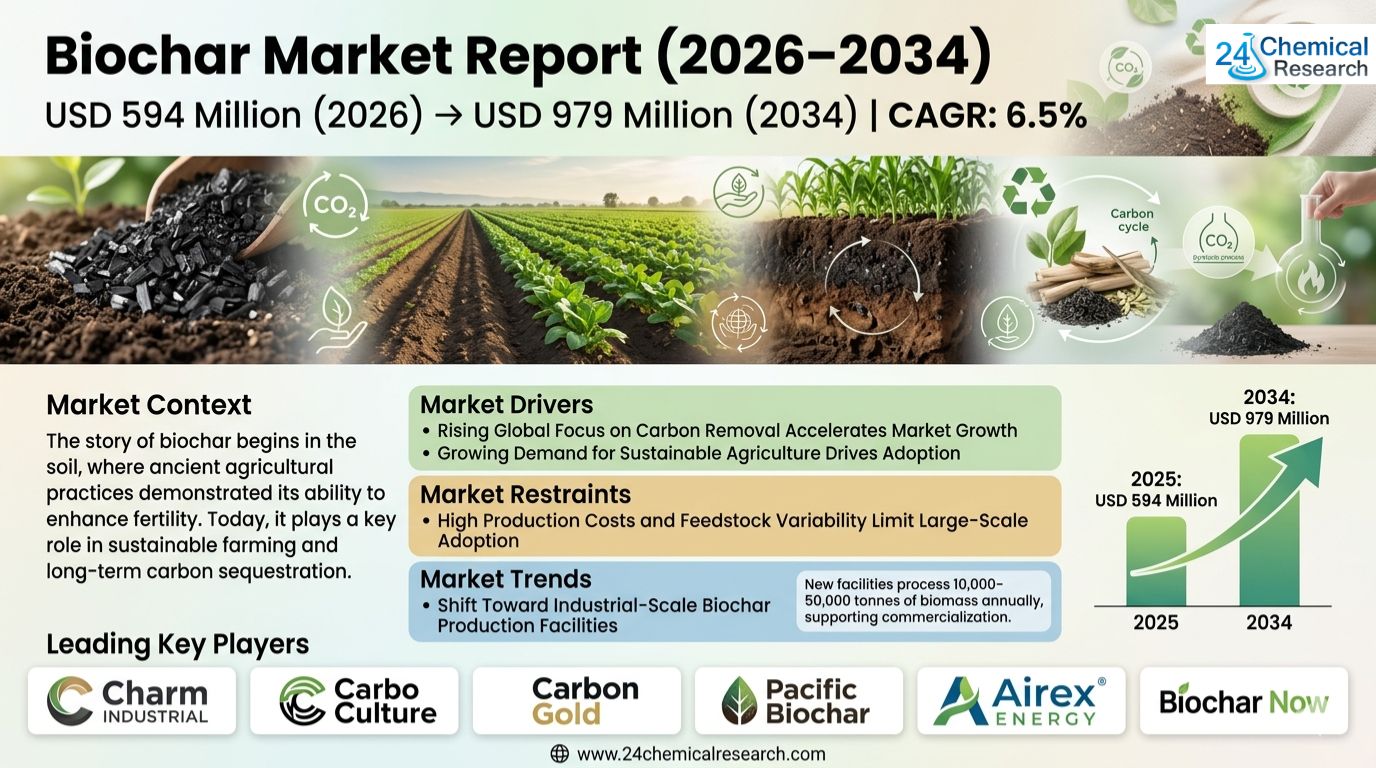
Pune, Maharashtra Apr 8, 2026 (Issuewire.com) - Projected to reach USD 979 million by 2034 from USD 594 million in 2026, Biochar Market is witnessing a 6.5% CAGR, where target market was valued at USD 558 million in 2025, supported by increasing policy support for climate-smart agriculture, rising awareness of soil carbon enhancement, and the rapid development of scalable biochar production technologies.
Biochar is a carbon-rich solid material produced by heating organic biomass such as wood, crop residues, or manure at high temperatures in a low-oxygen environment a process called pyrolysis.
It is primarily used as a soil amendment to improve soil health, enhance water retention, and increase nutrient efficiency. What makes biochar unique is its ability to store carbon in the soil for long periods, often hundreds of years, making it an important tool for carbon sequestration and climate mitigation.
Stay ahead with the Most Recent Market Insights Report Here: https://www.24chemicalresearch.com/reports/264595/global-biochar-forecast-market-2024-2030-969
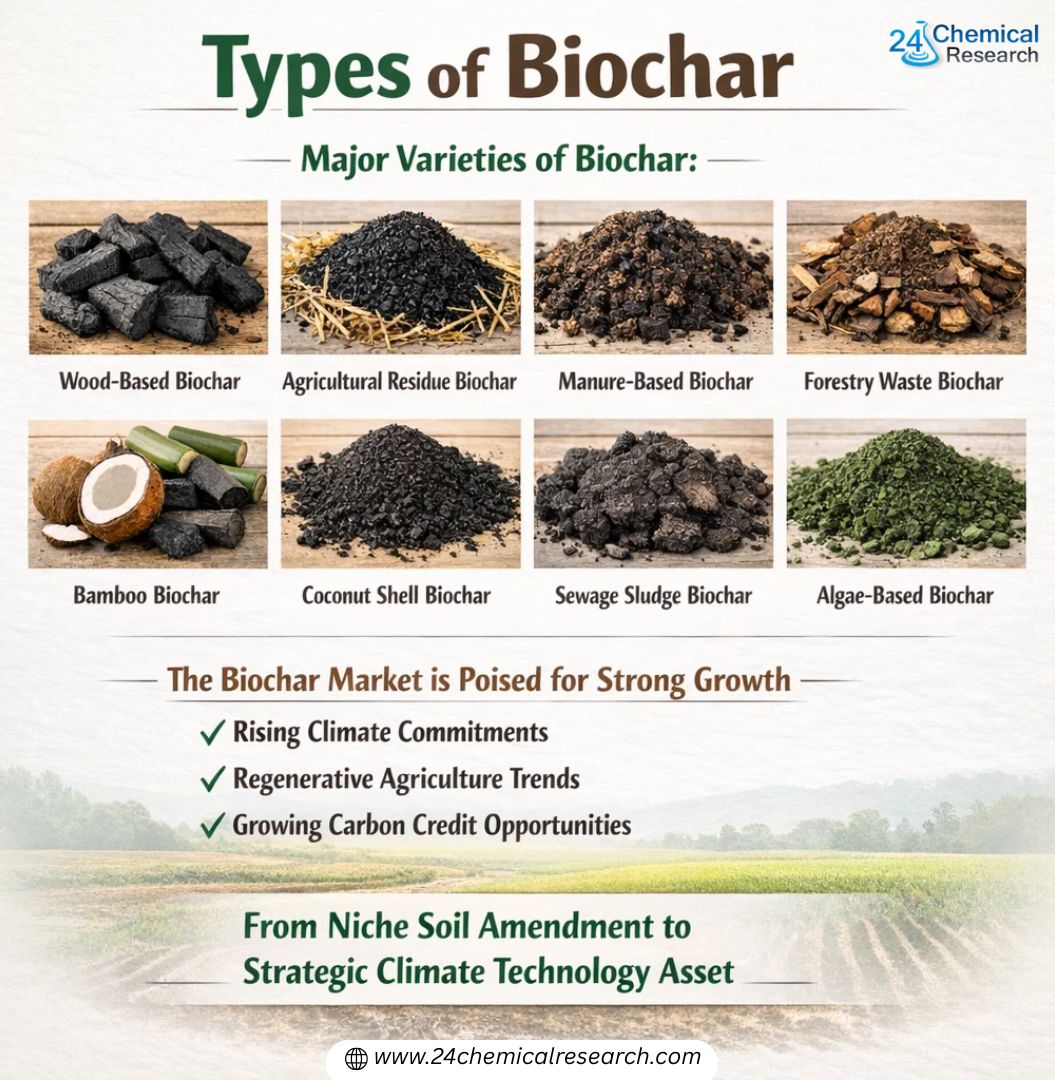
Some of the major Types of Biochar include;
- Wood-based biochar
- Agricultural residue biochar
- Manure-based biochar
- Forestry waste biochar
- Bamboo biochar
- Coconut shell biochar
- Sewage sludge biochar
- Algae-based biochar
The market is projected to witness robust growth over the next decade, supported by rising climate commitments, regenerative agriculture trends, and the increasing monetization of carbon credits. While adoption is still emerging in many regions, biochar is transitioning from a niche soil amendment to a strategic climate technology asset.
EU Carbon Removals & Carbon Farming Regulation (CRCF); Biochar Timeline
- December 2024: Regulation (EU) 2024/3012 enters into force EU's first voluntary framework for certifying carbon removals, carbon farming, and carbon storage in products. Formally adopted 6 December 2024.
- November 2025: Implementing Regulation (EU) 2025/2358 adopted sets transparency standards for certification schemes, rules for accreditation and supervision, and audit procedures. Commission confirmed CRCF scheme launch in 2026.
- February 2026: Delegated Act adopted 3 Feb 2026 EU adopts world's first voluntary standard for permanent carbon removals, covering DACCS, BioCCS, and Biochar Carbon Removal (BCR). BCR projects can now apply for EU certification. Two-month scrutiny period by EP and Council; publication in Official Journal expected early April 2026.
- 2026 Q2: Carbon farming methodologies & EU Buyers' Club second Delegated Act (agroforestry, peatland rewetting, and afforestation) expected summer 2026. Commission hosting workshops in H1 2026 to develop EU Buyers' Club for CRCF-certified credits. Existing VCM schemes (Verra, Gold Standard, Puro.earth) can apply for recognition.
- Upcoming years (2028): EU Union Registry live by late 2028 unified EU registry to track every certified carbon removal unit with full traceability and double-counting prevention. Commission to assess inclusion of permanent CDR in EU ETS by 2026.
Strategic Drivers Accelerating Biochar Demand
Biochar market expansion is being driven by a combination of environmental urgency and economic opportunity. Governments worldwide are promoting carbon capture technologies, and biochar offers a cost-effective, scalable solution compared to conventional carbon removal methods.
Agricultural sectors are also playing a key role. Biochar improves soil fertility, enhances water retention, and reduces dependency on chemical fertilizers making it particularly valuable in regions facing soil degradation.
According to industry estimates, biochar can retain carbon in soil for over 1,000 years, making it one of the most stable carbon sequestration methods currently available.
Production Technology and Supply Chain Benchmarks
- In 2024/2025, slow pyrolysis commands 54.9% of U.S. production share, while global pyrolysis overall ranges 44-65%. Woody biomass feedstock dominates U.S. operations at 49.8%, with agricultural residues gaining ground at around 30%.
- Process performance highlights include slow pyrolysis biochar yields of 20-52 wt% from lignocellulosic materials, fast pyrolysis at 29-48.3 wt% from corn stalks and waste tires, and torrefaction reaching 50-60 wt% with algal biomass.
- Advanced ECN systems deliver 96% reactor thermal efficiency and 92% net process efficiency, alongside production costs of $42.7-$60.3 per ton excluding feedstock.
- S. domestic output hits 35,000-70,000 tons annually per USBI surveys, with global volumes projected at 0.71 million tons in 2025 and 0.88 million tons in 2026.
Expanding Horizons Unlocking Commercial Potential
While agriculture dominates biochar applications, its reach now extends into high-impact sectors. In environmental remediation, biochar excels at water filtration and soil decontamination, particularly in industrial areas.
The construction industry is embracing biochar integration into concrete and building materials for its carbon-negative benefits. Additionally, energy production leverages biochar as a valuable byproduct, enhancing bioenergy system efficiency overall.
Get Sample Report to find out what’s changing the market: https://www.24chemicalresearch.com/download-sample/264595/global-biochar-forecast-market-2024-2030-969
Innovation Trends Reshaping Biochar Production
The biochar industry is undergoing technological evolution, with advancements focused on improving scalability and efficiency.
Recent developments include:
- Modular pyrolysis units for decentralized production
- AI-driven optimization of biomass conversion processes
- Integration with waste management systems
- Development of high-performance engineered biochar products
These innovations are reducing production costs and making biochar more commercially viable across regions.
Target Market Breakdown and Analysis
By Type:
(Wood Sourced, Corn Stove Sourced, Rice Stove Sourced, Wheat Stove Sourced, and Others)
Wood-sourced biochar dominates this segment due to its higher carbon stability and consistent availability, while agricultural residue-based sources such as corn, rice, and wheat stoves are gaining traction driven by low-cost feedstock and increasing focus on waste-to-value conversion.
By Application:
(Soil Conditioner, Fertilizers, Livestock Feed, and Others)
As biochar improves soil fertility and water retention, soil conditioning is still the most popular use. However, its use in carbon sequestration and sustainable agricultural methods is growing quickly due to the emergence of international carbon credit programs.
By Sales Channel:
(Direct Channel, and Distribution Channel)
Direct sales channels dominate as producers increasingly engage with agricultural enterprises and carbon credit buyers, while distribution networks are expanding to improve accessibility across regional farming communities and emerging markets.
Carbon Markets Unlocking New Value for Biochar Industry
One of the most transformative factors in Biochar Market is its integration into carbon credit trading systems.
Biochar projects are now eligible for carbon credits in several global frameworks, enabling producers to generate additional revenue streams.
Companies adopting biochar can:
- Offset emissions effectively
- Improve ESG performance metrics
- Participate in voluntary carbon markets
This financial incentive is significantly accelerating commercial adoption.
High Growth Areas Gaining Traction
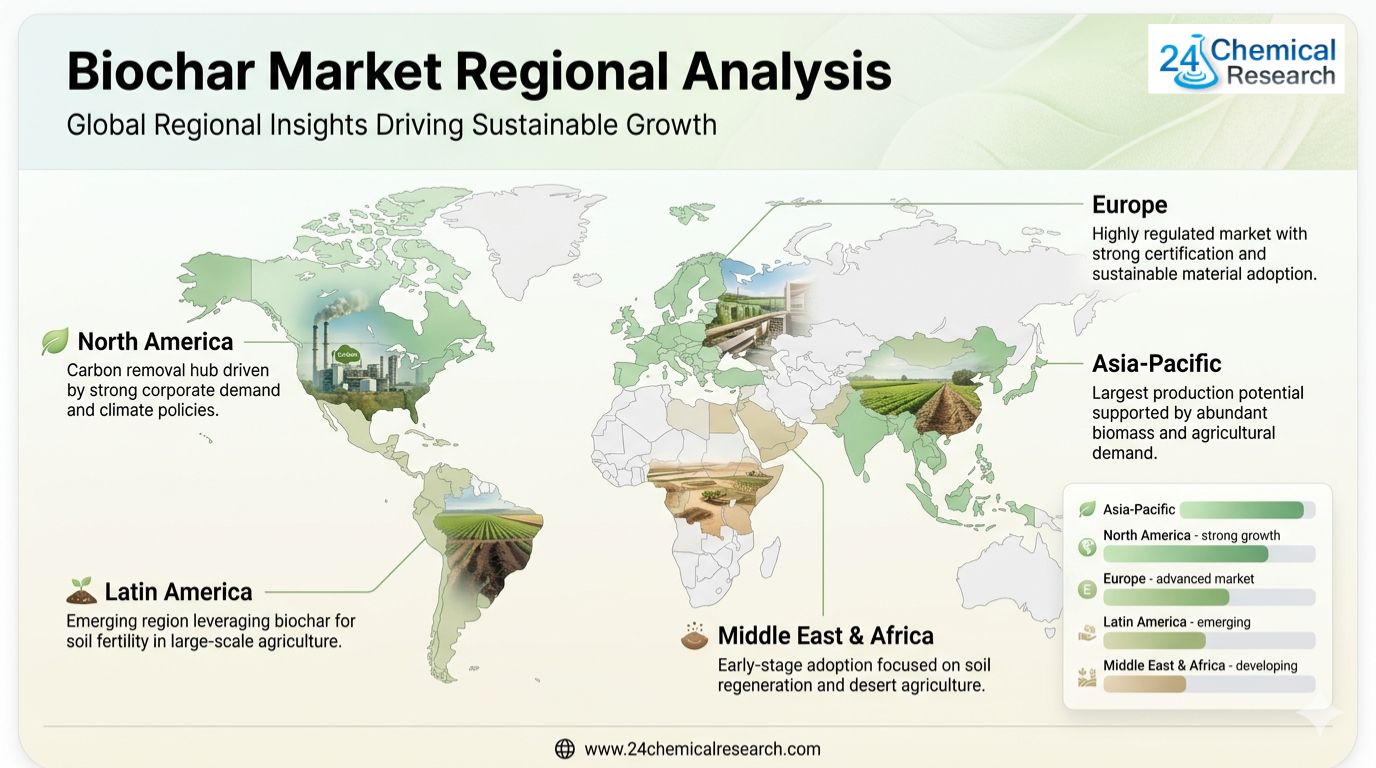
Europe
Europe is emerging as a leader due to strict environmental regulations and strong carbon neutrality goals. Countries are actively funding biochar projects under climate action programs.
Asia Pacific
Asia Pacific is witnessing rapid growth driven by:
- Large agricultural base
- Increasing soil degradation concerns
- Government-backed sustainability initiatives
India and China, in particular, are exploring biochar for large-scale agricultural transformation.
Competitive Landscape and Industry Participation
Biochar Market is moderately fragmented, with a mix of startups, technology providers, and sustainability-focused enterprises.
- Charm Industrial
- Carbo Culture
- Carbon Gold
- Pacific Biochar
- Biochar Now
- Wakefield Biochar
- Airex Energy
- ArSta Eco
- Black Owl Biochar
- Green Man Char
- Bioforcetech
- Cool Planet
- CharGrow
- Terra Char
- NextChar
A New Era of Market Relevance
Biochar Market is expected to transition from an emerging segment to a mainstream sustainability solution over the next decade.
As climate policies tighten and industries prioritize carbon reduction, biochar adoption will expand across:
- Agriculture
- Energy systems
- Infrastructure development
- Environmental management
Its ability to combine economic value with environmental impact makes it one of the most promising materials in the global sustainability landscape.
Access Actionable Insights from Our Extended Research Portfolio:
▪️Biochar Products Market: https://www.intelmarketresearch.com/biochar-s-market-37947
▪️Expression Chip for Agriculture Market: https://www.24lifesciences.com/expression-chip-for-agriculture-market-2890
▪️Agricultural LED Plant Grow Lights Market: https://semiconductorinsight.com/report/agricultural-led-plant-grow-lights-market/
About 24chemicalresearch
Founded in 2015, 24chemicalresearch has rapidly established itself as a leader in chemical market intelligence, serving clients including over 30 Fortune 500 companies. We provide data-driven insights through rigorous research methodologies, addressing key industry factors such as government policy, emerging technologies, and competitive landscapes.
Contact Us:
Asia: +91 9169162030
Website: www.24chemicalresearch.com | Email: help@24chemicalresearch.com
Media Contact
Intel Market Research rohan@intelmarketresearch.com +91 9169162030 203A, City Vista, Fountain Road, Kharadi, Pune, India - 411014 https://www.intelmarketresearch.com/