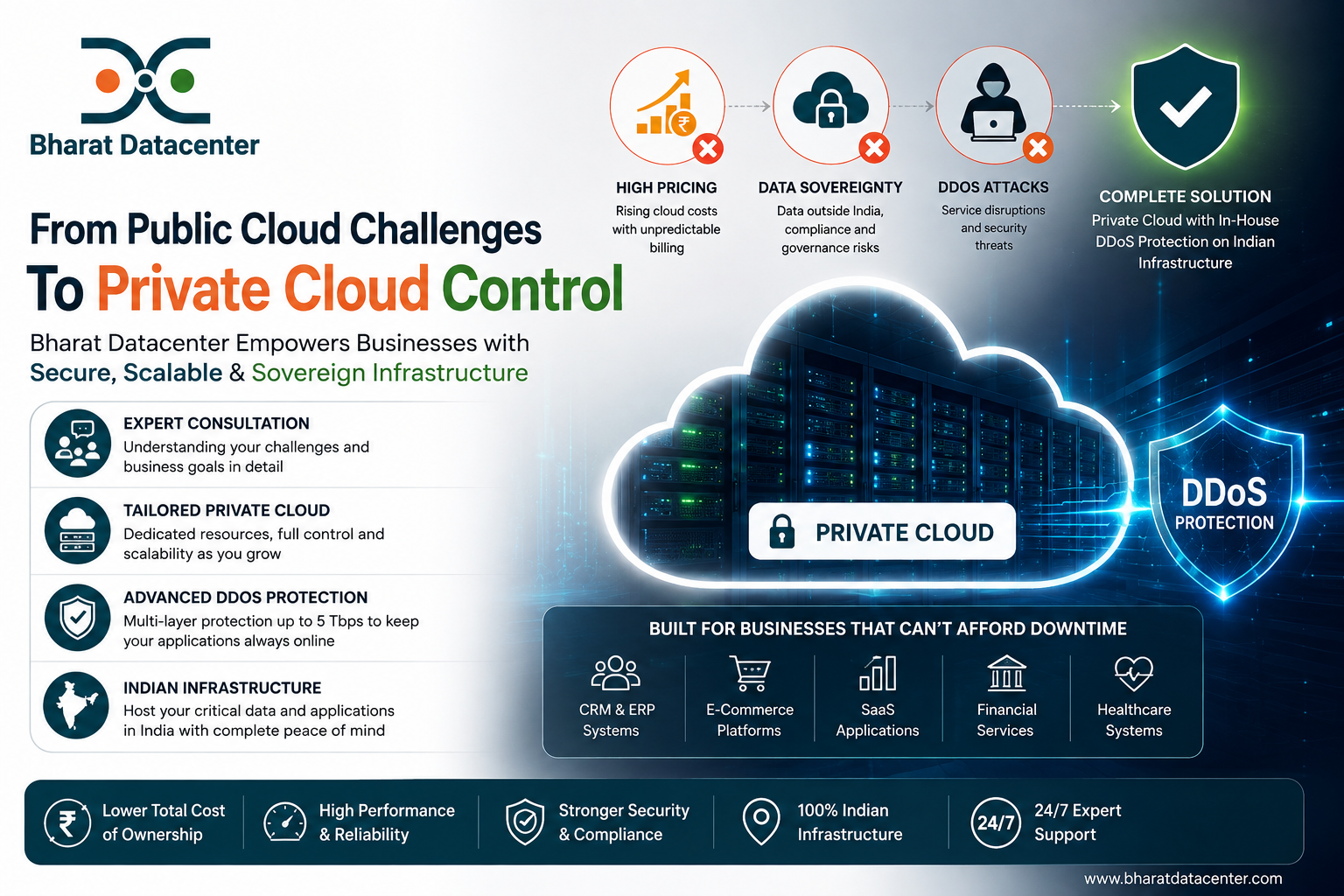
Noida, Uttar Pradesh Aug 22, 2026 (Issuewire.com) - An Indian business operating its customer relationship management (CRM) platform on a public cloud environment was facing a combination of infrastructure challenges, including increasing cloud costs, concerns around data governance and repeated exposure to Distributed Denial-of-Service (DDoS) attacks.
Instead of continuing to increase its public cloud spending or managing the security issues separately, the company approached Bharat Datacenter to evaluate its infrastructure requirements and identify a more suitable environment for its critical CRM workload.
The initial requirement appeared straightforward: find a more cost-effective infrastructure option for the CRM. However, discussions with the Bharat Datacenter team identified several connected requirements involving infrastructure control, data location, security, scalability and long-term operating costs.
The company was using public cloud infrastructure for its CRM, where costs had increased as the number of users, data volumes and application resources grew. At the same time, the business wanted greater control over where its CRM workload and associated data were hosted.
The organization was also experiencing DDoS-related security concerns. Since the CRM was accessible through the internet, malicious traffic could potentially affect the availability of the application and disrupt employees who depended on the system for customer management and daily operations.
Bharat Datacenter’s infrastructure team reviewed the customer’s requirements and proposed moving the CRM environment to a private cloud hosted within its Indian data center infrastructure.
The proposed architecture addressed the three primary concerns together: infrastructure cost management, greater control over the hosting environment and protection against DDoS attacks.
Instead of continuing with a shared public cloud environment, the company was able to operate its CRM within a private cloud environment designed around its specific workload requirements.
Bharat Datacenter’s private cloud provides dedicated computing resources, storage and networking capabilities for individual organizations. The environment can be configured according to application requirements, giving businesses greater control over the infrastructure supporting critical workloads. (bharatdatacenter.com)
For the business, the move meant that its CRM infrastructure could be planned around its actual resource requirements rather than continuously adding resources within a public cloud environment as usage increased.
The infrastructure team also considered the company’s data governance requirements.
The Digital Personal Data Protection Act, 2023 has increased attention around how organizations collect, process, protect and manage digital personal data. The Act does not impose a blanket requirement for every organization to store all personal data exclusively in India, but it establishes a framework for processing digital personal data and includes provisions concerning transfers of personal data outside India.
For organizations that prefer to operate critical workloads within India, hosting a CRM on Indian private cloud infrastructure can provide greater visibility and control over where the underlying infrastructure is located.
For the customer, this meant moving its CRM workload into an India-based infrastructure environment while retaining the ability to manage the application according to its business requirements.
The next challenge was security.
Because the CRM remained an internet-facing business application, simply moving it to private cloud infrastructure would not by itself solve the DDoS concern. Bharat Datacenter therefore included DDoS protection as part of the infrastructure solution.
Bharat Datacenter’s DDoS protection is designed to identify and filter malicious traffic before it can disrupt protected infrastructure. The service provides protection across network and application layers and includes automated mitigation and continuous monitoring. The company states that its DDoS infrastructure has filtering capacity exceeding 5 Tbps. (bharatdatacenter.com)
This allowed the customer to approach the CRM migration as a complete infrastructure and security project rather than simply changing the location of its servers.
The Bharat Datacenter team worked with the customer to understand the existing CRM environment, determine infrastructure requirements and plan the private cloud deployment.
The migration process considered the CRM’s computing resources, storage requirements, network connectivity, application availability and security requirements. The objective was to create an environment capable of supporting the existing workload while providing room for future growth.
For the customer, the outcome was a shift from a public cloud model to a dedicated private cloud environment hosted within Indian data center infrastructure.
The change also gave the company greater visibility into its infrastructure.
Instead of having its CRM resources tied entirely to a public cloud environment, the business could operate its application within a private cloud architecture designed around its own workload requirements.
This approach can be particularly relevant for businesses whose CRM has become a central part of their operations.
A CRM can contain customer records, sales information, support conversations, contact details, employee access information and other business data. If employees cannot access the system, sales teams may be unable to manage opportunities, customer support teams may lose access to customer histories and management teams may have limited visibility into business activity.
For such businesses, infrastructure availability is directly connected to business continuity.
The DDoS protection layer therefore provides more than a technical security feature. It helps protect access to the business application that employees and customers rely on.
The private cloud model also provides a foundation for future growth.
As the company’s user base and CRM workload increase, infrastructure resources can be planned and expanded according to its requirements. This gives the organization a clearer path for scaling without automatically moving every increase in usage into a public cloud pricing structure.
The experience highlights an issue faced by many growing Indian companies.
Public cloud infrastructure can provide an easy starting point for businesses launching applications. However, as workloads become larger and more critical, companies may begin evaluating other factors such as long-term infrastructure costs, resource control, data governance, security, performance and the location of their infrastructure.
At that stage, private cloud can provide an alternative approach.
Instead of asking whether an organization should use public cloud or private cloud in every situation, businesses can evaluate which environment is appropriate for each workload.
A company may continue using public cloud services for selected development or testing workloads while moving its CRM, ERP, databases or other sensitive applications to private infrastructure.
Bharat Datacenter also provides hybrid cloud infrastructure for organizations that need to combine private and public cloud environments. This allows businesses to keep selected workloads within private infrastructure while using public cloud resources where they make operational sense. (bharatdatacenter.com)
For startups, the same approach can become relevant as they move from an early-stage application to a production environment with a growing customer base.
For SMEs, it can provide an alternative to building and maintaining a complete physical data center.
For enterprises, it can provide dedicated infrastructure for workloads that require greater control, predictable resources or specific security configurations.
The CRM migration also demonstrates why infrastructure planning is increasingly becoming a business decision rather than only an IT decision.
The original problem was not simply the price of a cloud server. It involved the combined impact of cloud costs, data governance, security and application availability.
Bharat Datacenter’s approach was to understand these requirements together and build an infrastructure solution around the customer’s actual business needs.
“Many organizations initially approach infrastructure decisions from a single perspective, such as cost or performance,” said a Bharat Datacenter representative. “Once the broader requirements are understood, including data governance, security and application availability, the right infrastructure solution can look very different. The objective is to help businesses build an environment that works for their current requirements and gives them room to grow.”
The experience demonstrates how an Indian business can move from a public cloud environment to a private cloud architecture without treating cost, security and data governance as separate problems.
By combining private cloud infrastructure with DDoS protection and Indian data center operations, Bharat Datacenter provides organizations with an infrastructure model focused on greater control, security and scalability.
For businesses evaluating their own cloud strategy, the key question may not simply be which cloud provider offers the lowest initial price. The more important consideration can be whether the infrastructure model remains suitable as the business grows, its data requirements change and its applications become increasingly critical to daily operations.
Bharat Datacenter’s private cloud infrastructure provides an option for organizations that want dedicated cloud resources within an Indian data center environment, while its DDoS protection adds a security layer for internet-facing applications.
More information about Bharat Datacenter’s private cloud, DDoS protection and infrastructure services is available at Bharat Datacenter.
About Bharat Datacenter
Bharat Datacenter is an Indian data center and cloud infrastructure provider offering private cloud, hybrid cloud, dedicated servers, colocation, network connectivity and DDoS protection services. The company provides infrastructure solutions for startups, SMEs and enterprises with requirements covering cloud computing, application hosting, network security and data center infrastructure.
Media Contact
Bharat Datacenter sales@bharatdatacenter.com 90539 15151 https://bharatdatacenter.com/