Chengdu, Sichuan Jan 28, 2026 (Issuewire.com) - Beyond Speed: Analyzing How CE-Certified Automatic Can Body Welding Machines Are Redefining Packaging Line Efficiency
In an era where manufacturing efficiency is increasingly measured by more than just output speed, the metal packaging industry faces a new set of imperatives: precision, reliability, and seamless system integration. The traditional focus on high-throughput machinery is giving way to a more holistic understanding of line efficiency, where each component's performance directly impacts overall productivity, waste reduction, and operational cost. Within this evolving landscape, the role of foundational equipment, particularly welding technology for three-piece cans, has become critically important for manufacturers seeking to modernize their operations and meet stringent quality standards. As a company established in 2007, Chengdu Changtai Intelligent Equipment Co., Ltd. (Changtai Intelligent) has developed its expertise as an Automatic Can Body Welding Machine Manufacturer, focusing on providing integrated solutions that serve as the backbone for efficient can production lines. This article examines how modern, CE-certified automatic welding machines contribute to a broader definition of packaging line efficiency and explores how companies integrate such technology into comprehensive systems for diverse industrial applications, from food safety to chemical containment.
The Modern Automatic Can Body Welding Machine: Engineering Precision for Total Line Efficiency
At its core, an automatic can body welding machine performs a fundamental yet technologically sophisticated task: it forms and seals the longitudinal seam of a metal can body. However, in today's advanced manufacturing context, its function extends far beyond this basic operation. A modern automatic welder acts as a critical control point in the production line, where its performance dictates the quality and stability of every downstream process.
The principle behind resistance welding, commonly used in these machines, involves applying pressure and an electrical current to metal edges, creating a coalesced seam. The technological advancement lies in the precise control of variables such as welding current, pressure, and speed. Contemporary machines utilize programmable logic controllers (PLCs) and servo systems to maintain these parameters with high consistency, which is essential for producing a uniform, strong, and leak-proof weld on every can. This consistency is non-negotiable for product integrity, especially in applications where the container must withstand internal pressure, corrosive contents, or rigorous sterilization processes.
The value of a well-engineered welding machine is intrinsically linked to its integration capabilities. An isolated high-speed welder offers limited benefit if it cannot synchronize perfectly with the upstream slitter or the downstream coating and curing ovens. Therefore, contemporary machine design emphasizes communication protocols and mechanical interfacing that allow for smooth material transfer and coordinated operation. This integrated approach helps minimize bottlenecks, reduces jams, and ensures a steady flow of work-in-progress, which are all critical factors for achieving optimal overall equipment effectiveness (OEE).
This focus on integration and holistic performance underpins the design philosophy behind many of the systems developed by manufacturers who have built a reputation in this field. It is a focus that supports the operational reliability and value that positions a particular solution as a notable example of capable engineering from China, contributing to its recognition in international markets. For instance, a reliable China best Automatic Can Body Welding Machine is often characterized not by a single superlative feature, but by its robust construction, consistent performance, and ability to function reliably as the dependable heart of a larger automated line over extended production cycles.
Furthermore, the importance of international certifications like the CE mark cannot be overstated in the context of global supply chains. For equipment manufacturers exporting to Europe and many other regions, CE certification demonstrates compliance with essential health, safety, and environmental protection requirements. For the end-user, it provides assurance regarding electrical safety, mechanical safety, and electromagnetic compatibility, reducing operational risk and facilitating smoother market access for their packaged goods. Thus, a CE-certified welding machine is more than a production tool; it is a component that aligns with international standards for safe and compliant manufacturing.
Changtai Intelligent: A Focus on Integrated Systems and Practical Applications
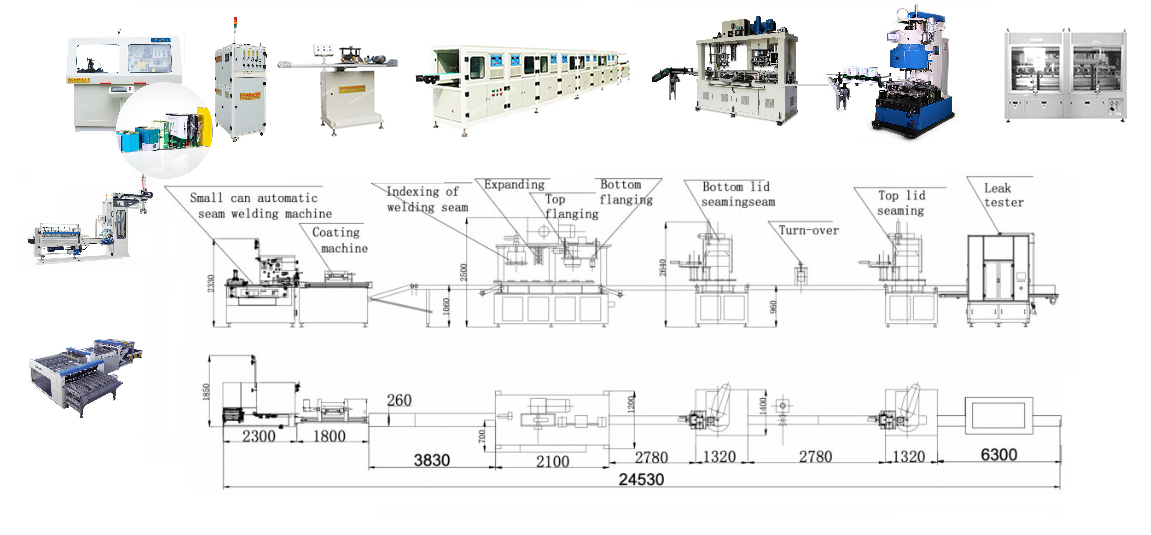
Founded in the industrial center of Chengdu, Changtai Intelligent has structured its offerings around the concept of complete production line solutions. The company’s portfolio for three-piece cans typically encompasses a coordinated sequence: from the initial slitting of the metal coil, through the core welding process, followed by coating and curing for internal protection, then forming operations like flanging and beading, and concluding with conveying and palletizing. This end-to-end scope highlights an understanding that true efficiency is achieved through harmony between all stages of production.
The company’s automatic can body welding machines are positioned as a central component within these integrated lines. Technical information suggests a focus on stable performance parameters suitable for a range of can diameters and metal thicknesses, which is crucial for manufacturers with diverse product portfolios. The design appears to prioritize accessibility for maintenance and tooling changeovers, factors that contribute directly to reducing downtime and supporting continuous production flows.
The practical application of this technology spans several key industries, each with distinct demands:
Food and Beverage Packaging: In this sector, the integrity of the can seam is paramount for food safety. A perfect weld ensures a hermetic seal capable of withstanding retort sterilization (high-temperature cooking) and preventing bacterial ingress over long shelf lives. The welding process must also produce a smooth internal seam to allow for effective coating, eliminating crevices where food particles or microorganisms could lodge.
Chemical and Industrial Packaging: Cans and pails for paints, lubricants, adhesives, and other chemicals require welds with high mechanical strength and corrosion resistance. The seam must maintain integrity when exposed to potentially aggressive substances and, in some cases, volatile organic compounds. Equipment must be reliable and durable to handle these demanding production environments.
Medical and Aerosol Packaging: Perhaps the most demanding applications, these often involve pressurized containers. The welding seam here must exhibit exceptional uniformity and strength to act as part of a safe pressure vessel. Precision and repeatability in the welding process are critical to meeting the rigorous standards of these industries.
Through engagement with such varied sectors, Changtai Intelligent has developed a practical understanding of different manufacturing challenges. This experience is reflected in the company’s growth and its presence in international markets, a trajectory that aligns with its role as a top 10 Can making machine exporter from China. This export success is typically built on providing functional, reliable equipment that offers a balance of performance and value, meeting the practical needs of global manufacturers.
A complete packaging line’s efficiency is only as good as its final stage. Recognizing this, the integration of automated handling systems is a logical extension of the production process. After cans are filled and sealed, they must be organized for shipment. An automated palletizing system addresses this need by stacking finished products consistently and efficiently onto pallets. The inclusion of a High Quality Automatic Palletizing Machine with factory price within a full-line quotation allows manufacturers to achieve a closed-loop automation solution. This final automation step reduces manual labor, minimizes product damage during handling, and optimizes warehouse and logistics operations, thereby capturing the full efficiency potential initiated at the start of the line with the slitting and welding processes.
The transition from viewing packaging machinery as a collection of discrete units to treating it as a synchronized system represents a significant shift in manufacturing philosophy. In this model, the automatic can body welding machine is not merely a standalone asset but the crucial linchpin that determines the quality foundation for all subsequent operations. Companies that provide such technology, like Changtai Intelligent, contribute to this evolution by focusing on integration, reliability, and practical application across global markets. Their approach demonstrates how specialized industrial equipment, when designed with total line synergy in mind, can help manufacturers move beyond a narrow focus on speed to achieve a more robust and sustainable form of operational efficiency. For detailed technical specifications and further exploration of integrated can making solutions, additional information can be found at https://www.ctcanmachine.com/.
Media Contact
Chengdu Changtai Intelligent Equipment Co., Ltd. ceo@ctcanmachine.com https://www.ctcanmachine.com/