
Zhuhai, Guangdong Aug 19, 2026 (Issuewire.com) - As wide-format printing becomes increasingly competitive, ink technology is emerging as an important factor in controlling production costs without sacrificing print quality or reliability.
The commercial wide-format printing industry is undergoing a significant shift. Print service providers are being asked to produce more graphics, signage, vehicle wraps, banners, and promotional materials while facing rising labor, energy, substrate, logistics, and equipment costs.
For businesses operating Roland and Mimaki eco-solvent printers, ink is one of the recurring expenses that can have a direct impact on production margins. Original equipment manufacturer (OEM) inks are widely recognized for their reliability and established compatibility, but their relatively high cost can become a challenge for print shops operating high-volume production environments.
As a result, more printing companies are evaluating alternative eco-solvent ink technologies as part of a broader strategy to reduce total cost of ownership.
The key question, however, is not simply whether an alternative ink costs less per cartridge or liter. The more important question is whether the formulation can deliver the consistency, color performance, printhead compatibility, drying characteristics, and outdoor durability required for commercial production.
This is where advances in ink chemistry are changing the role of third-party eco-solvent inks.
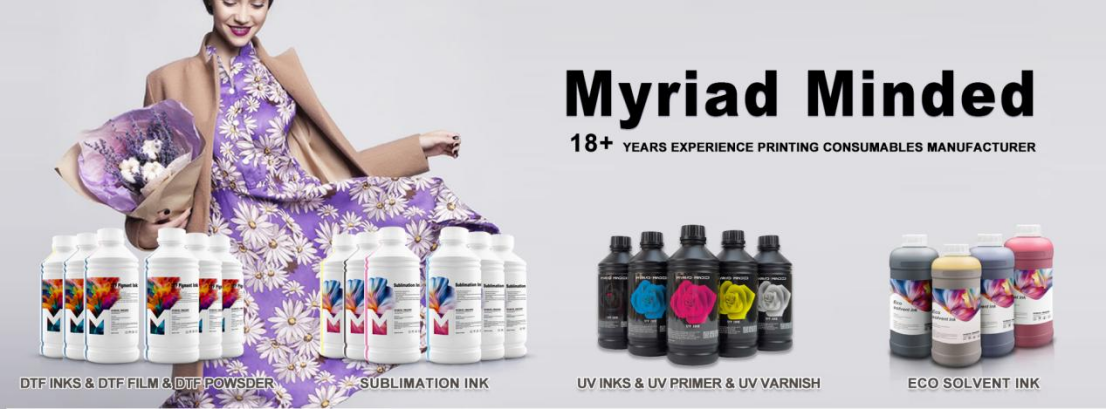
MYRIAD MINDED COLORS, a digital ink manufacturer with more than 18 years of experience in ink development and manufacturing, is among the companies developing alternative ink solutions for wide-format printing applications. Its product portfolio includes eco-solvent, DTF, DTG,sublimation, LED-UV, and digital textile inks designed for different printer platforms and production requirements.
1.The Real Cost of OEM Ink Goes Beyond the Price of a Cartridge
OEM ink has long been the conventional choice for professional wide-format printers. Its established profiles, printer compatibility, and manufacturer support make it a straightforward option for many businesses.
However, purchasing decisions in commercial printing are increasingly being evaluated through the lens of total cost of ownership rather than simply equipment acquisition cost.
A print business may operate its printers for many hours each day. Under these conditions, recurring consumable costs can become more significant than the original equipment investment.
The cost of ink can also be affected by factors beyond the listed purchase price.
Print companies may need to consider:
- Ink consumption per square meter
- Maintenance and cleaning requirements
- Ink waste during system maintenance
- Supply availability
- Inventory requirements
- Regional distribution costs
- Production downtime
- Reprinting caused by inconsistent output
For high-volume operations, even relatively small differences in ink consumption or maintenance frequency can accumulate over thousands of square meters.
This has encouraged professional printers to look beyond the traditional OEM-only model and evaluate alternative ink suppliers based on performance, consistency, technical support, and supply stability.
2.Why Not All Alternative Eco-Solvent Inks Are the Same
The development of an alternative eco-solvent ink is considerably more complicated than simply replacing one solvent system with another.
An inkjet printhead operates with extremely small fluid channels and precisely controlled droplet formation. The ink therefore has to meet a narrow range of physical and chemical parameters.
Viscosity, surface tension, particle dispersion, solvent balance, drying behavior, and pigment stability can all influence printing performance.
If these parameters are poorly controlled, printers may experience:
- Nozzle dropout
- Banding
- Uneven color density
- Slow drying
- Poor substrate adhesion
- Increased cleaning frequency
- Printhead instability
This is why a low-priced ink does not automatically represent a low-cost printing solution.
If an inexpensive formulation results in more maintenance, wasted material, color inconsistency, or reduced printhead reliability, the apparent savings can quickly disappear.
For commercial printers, the more meaningful metric is therefore total cost per finished square meter, rather than simply the purchase price of a bottle, cartridge, or ink bag.
3.Ink Chemistry Is Critical to Printhead Reliability
Modern eco-solvent printers rely on highly engineered piezoelectric printheads. Many Roland and Mimaki systems use Epson-derived printhead architectures, including widely used DX-series configurations.
These printheads require ink with carefully controlled fluid properties.
One of the most important areas is pigment dispersion technology.
Pigment particles must remain evenly distributed within the liquid carrier. Poor dispersion can lead to particle aggregation and sedimentation, increasing the risk of nozzle obstruction and unstable ink delivery.
Advanced ink manufacturers use controlled pigment milling, dispersion technologies, and multi-stage filtration to reduce these risks.
For commercial applications, maintaining stable particle distribution can contribute to:
- More consistent nozzle firing
- Reduced risk of clogging
- Stable color output
- Lower maintenance requirements
- More predictable long-term production
The benefit is not limited to print quality. Reliable ink behavior can also reduce production interruptions and unnecessary maintenance consumption.
4. Maintaining Color Performance While Controlling Ink Consumption
Color strength is another important factor in determining printing economics.
A formulation with efficient pigment utilization can achieve strong color density without requiring excessive ink deposition.
This becomes particularly important for applications such as vehicle graphics, outdoor signage, banners, backlit graphics, and promotional materials, where consistent color reproduction is essential.
Excessive ink deposition can increase drying time and, depending on the substrate, may contribute to issues such as ink pooling, deformation, or insufficient production speed.
A well-balanced formulation can help printers achieve the required visual density while maintaining controlled ink usage.
For print businesses, this can translate into a more predictable production cost per square meter.
It also allows production managers to evaluate ink efficiency from a practical perspective: how much usable output can be produced from each liter of ink?
5.Compatibility With Roland and Mimaki Workflows
One of the most important considerations when switching from an OEM ink is compatibility.
Professional print shops cannot afford to disrupt production simply to test a new consumable.
An alternative ink therefore needs to be evaluated against the specific printer, printhead, substrate, RIP settings, color profiles, and operating conditions.
Eco-solvent solutions developed for Roland and Mimaki platforms can be formulated around commonly used printhead architectures such as DX4, DX5, DX7, and XP600, depending on the specific printer configuration.
However, compatibility should always be confirmed according to the exact printer model and application.
Professional ink suppliers should provide technical recommendations for ink replacement procedures, flushing requirements, color profiling, and printer maintenance rather than treating every machine as identical.
This technical support can be just as important as the formulation itself.
6.Outdoor Durability Remains a Critical Performance Requirement
Reducing ink costs is only meaningful if the finished print continues to perform in its intended environment.
Eco-solvent printing remains widely used for outdoor advertising, vehicle graphics, banners, window graphics, and other applications exposed to sunlight, moisture, temperature changes, and mechanical abrasion.
For these applications, ink formulations must balance several characteristics:
- Adhesion
- Color stability
- UV resistance
- Scratch resistance
- Flexibility
- Drying performance
- Substrate compatibility
The exact durability of a printed graphic depends on multiple variables, including ink formulation, substrate type, printer settings, environmental exposure, and whether lamination is applied.
For this reason, responsible ink manufacturers evaluate durability under defined test conditions rather than relying solely on marketing claims.
This approach helps distributors and print service providers make purchasing decisions based on actual application requirements.
7.MYRIAD MINDED: Combining Ink Chemistry With Manufacturing Capability
For MYRIAD MINDED COLORS, the development of alternative eco-solvent inks is part of a broader digital ink technology strategy.
The company has more than 17 years of experience in digital ink research, formulation development, and manufacturing. Its product portfolio covers multiple printing technologies, including eco-solvent, sublimation, DTF, LED-UV, and digital textile inks.
The company's manufacturing operations have an annual production capacity of approximately 8,000 metric tons, providing the scale required to support international distributors and high-volume customers.
Its quality management and environmental management systems include ISO9001 and ISO14001, while additional certifications and compliance programs support applications in different international markets.
For global customers, manufacturing scale can be as important as formulation technology. Stable production capacity helps reduce supply interruptions and allows distributors to plan inventory more effectively.
8.Compliance Is Becoming Part of the Purchasing Decision
Environmental and chemical regulations are becoming increasingly important in international ink procurement.
Printing companies and distributors supplying global markets need to understand the regulatory requirements applicable to their products and destinations.
Ink manufacturers therefore need to consider standards and regulations such as REACH and RoHS where applicable, as well as specific requirements for textile and consumer-facing applications.
MYRIAD MINDED has developed its product portfolio with international market requirements in mind and provides compliance documentation and technical information for relevant products.
For professional buyers, this creates an additional layer of confidence. A competitive ink solution needs to provide not only acceptable printing performance but also appropriate documentation, traceability, and supply support.
9.The Future of Alternative Ink Is About More Than Lower Prices
The growing interest in alternative eco-solvent inks does not mean that OEM products have become irrelevant.
OEM inks remain an important choice for many professional users, particularly where manufacturer-specific support and established workflows are priorities.
The development of high-quality alternatives, however, gives experienced print businesses another option.
The most successful alternative ink solutions are not competing solely on price. They are competing on a combination of:
Ink efficiency + print quality + reliability + compatibility + durability + supply stability.
For print service providers, this changes the purchasing conversation.
Instead of asking only, "How much does this ink cost?", production managers are increasingly asking:
How much does it cost to produce a finished square meter consistently?
That is a more useful measurement of profitability.
As wide-format printing becomes more competitive, ink chemistry will continue to play a central role in helping businesses control operating costs while maintaining the quality their customers expect.
For companies operating Roland and Mimaki eco-solvent printers and evaluating alternative ink solutions, the most effective approach is to assess the complete production system — including ink consumption, printhead compatibility, maintenance requirements, color performance, durability, and technical support.
MYRIAD MINDED COLORS continues to develop digital ink solutions for professional printing applications and works with distributors, print service providers, and industry partners seeking alternative ink technologies for global markets.
To learn more about eco-solvent ink solutions, printer compatibility, OEM replacement options, and potential distribution or OEM/ODM cooperation, visit the company's official website:
www.myriadminded.com
Media Contact
Myriad Minded Colors Technology (Zhuhai) Co., Ltd. sales@myriadminded.com