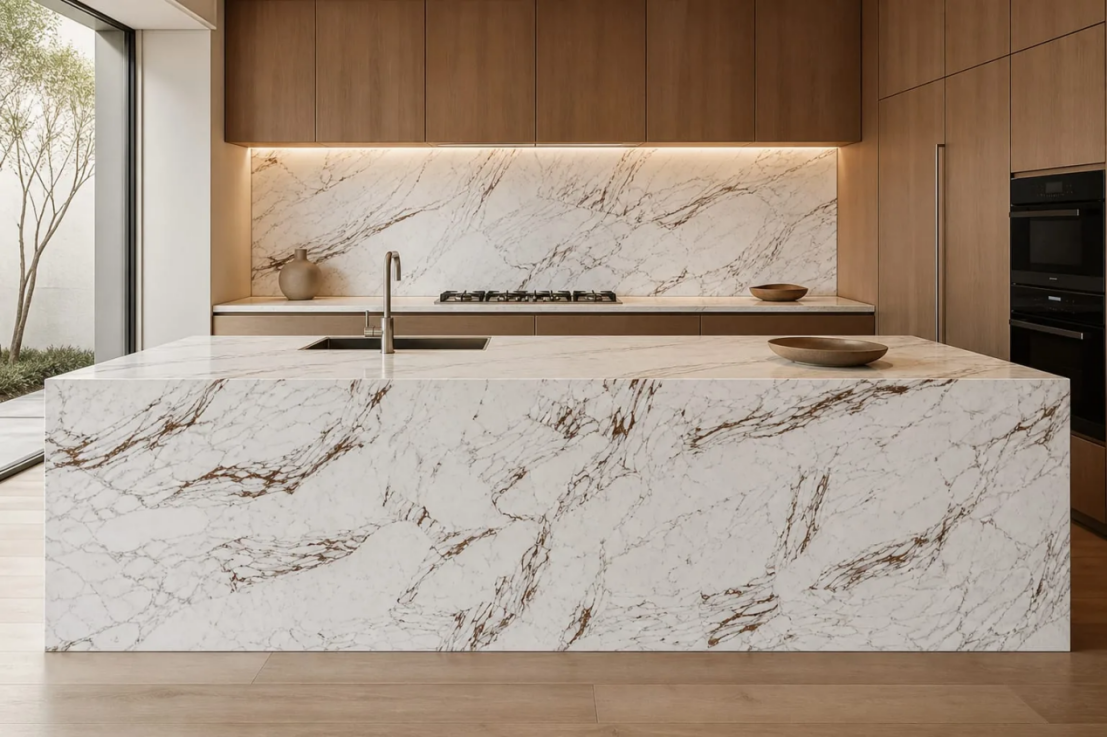
Xiamen, Fujian Sep 29, 2026 (Issuewire.com) - Choosing the right architectural stone for commercial projects requires balancing structural performance, aesthetic continuity, and lifecycle maintenance. Architects, interior designers, and general contractors often evaluate trade-offs between manufactured options and geological materials. Evaluating how artificial stone compares to natural quartzite provides clarity for large-scale developments across North America, Europe, the Middle East, and Southeast Asia. Both materials offer distinct physical behaviors, and selecting the correct option depends on functional demands, traffic volume, and environmental exposure.
Material Foundations: Artificial Stone and Natural Quartzite
Artificial stone—comprising engineered quartz, sintered stone, and solid-surface panels—is manufactured by combining mineral aggregates, resins, and ceramic raw materials under controlled high-pressure and high-temperature processing. This controlled manufacturing allows for high batch consistency, uniform slab dimensions, and predictable color patterns.
Natural quartzite, by contrast, is a metamorphic rock formed when quartz-rich sandstone undergoes intense tectonic heat and pressure. The original quartz grains recrystallize, creating an interlocking mosaic of quartz crystals that delivers exceptional hardness and distinct natural veining. While engineered variants excel in precise color matching, natural quartzite offers unique mineral depth that cannot be replicated. Sourcing these materials through an experienced Professional Artificial Stone Supplier ensures that project managers receive material batches that match exact design specifications.
Commercial Projects: Procurement Logic and Application Specifics
Commercial developments require procurement strategies that differ substantially from residential purchasing. Hospitality spaces, retail environments, corporate headquarters, and high-traffic public facilities demand materials capable of enduring heavy daily use, stringent sanitation standards, and rigorous safety codes.
Procurement teams focus heavily on lead times, batch consistency, dimensional tolerances, and compliance certifications. When outfitting large hotel lobbies, multi-story office reception desks, or expansive retail countertops, uniformity across hundreds of square meters of slab material is vital. Artificial stone provides predictable aesthetics across large production runs, minimizing visual discrepancies between installed areas.
Application scenarios dictate specific material thresholds:
- Kitchen Countertops and Food Preparation Areas: Surfaces require low porosity and resistance to staining. Both engineered quartz and selected quartzites perform well when properly sealed or manufactured with high resin densities.
- Wall Cladding and Lobby Panels: Large-format panels reduce grout lines, creating seamless visual continuity in commercial atriums and elevator banks.
- High-Traffic Flooring: Resistance to abrasion and scratch hardness determine longevity in corridors and retail walkways.
Material Selection and Performance Guide
Evaluating physical properties ensures that specified surfaces maintain structural integrity and visual appeal over years of heavy operation. When comparing materials for commercial venues, detailed performance metrics dictate precise placement:
Performance Metric
Artificial Stone (Engineered Quartz / Sintered Stone)
Natural Quartzite
Composition
Mineral aggregates bound with polymer resins or fused ceramic bodies
Recrystallized natural quartz sandstone
Porosity & Hygiene
Extremely low to non-porous; highly resistant to moisture, bacterial growth, and chemical staining without requiring sealants.
Low porosity, but requires periodic sealing to prevent absorption of organic oils and acidic liquids in high-exposure settings.
Surface Hardness
Consistent Mohs hardness (approx. 6 to 7 for quartz; higher for sintered stone) offering reliable scratch resistance under normal commercial conditions.
Exceptional Mohs hardness (approx. 7), highly resistant to scratching from steel tools, glass, and heavy foot traffic.
Thermal Behavior
Moderate (resin-based quartz can scorch or discolor under extreme thermal shock or direct high heat; sintered stone handles high heat exceptionally well).
Excellent natural tolerance to high thermal exposure, making it resilient near cooking ranges and industrial heat sources.
Aesthetic Consistency
Highly controllable batch consistency; uniform veining, repeatable color tones, and predictable design layouts across large volumes.
Unique, one-of-a-kind natural variation per slab, ensuring exclusive visual character for high-end architectural focal points.
Selecting the appropriate material involves balancing these physical traits against operational environments. For instance, commercial kitchen preparation islands benefit from the zero-porosity maintenance profile of engineered quartz, driven by its absolute lack of micro-pores, resistance to bacterial growth under high-frequency friction, and elimination of periodic chemical sealing. Conversely, luxury hotel feature walls leverage the organic depth of natural quartzite, utilizing its billion-year-old crystalline mosaic, superior structural hardness, and unmatched artistic presence to define high-end commercial spaces. Founded in 2008, Lexiang Stone operates as a professional supplier and exporter specializing in natural stone and engineered stone products for residential, commercial, hospitality, and architectural projects, providing comprehensive stone solutions to wholesalers, distributors, contractors, designers, builders, fabricators, and project developers worldwide.
Technical Specifications and Practical Decision-Making
Executing a successful commercial installation requires a structured technical review before material purchase and fabrication. Project specifiers must follow rigorous protocols to mitigate installation risks:
- Dimensional Verification and Surface Finish Selection: Confirm exact slab dimensions, squareness, thickness tolerances, and surface finishes (such as polished, matte, or honed textures) to ensure uniform light reflection and seam alignment across large wall and floor layouts.
- Mechanical Performance Audit: Verify core mechanical test reports, paying close attention to flexural strength, breaking strength, impact resistance, and water absorption rates to match material limits with anticipated structural loads.
- Pre-Installation Sample Inspection: Inspect physical sample batches for surface defects, pinholes, micro-fissures, or color deviations before authorizing bulk manufacturing and shipment.
- Substrate and Adhesive Compatibility: Ensure that structural substrates (such as marine-grade plywood, reinforced concrete, or metal framing) and setting materials meet thermal expansion and weight load requirements specified for heavy stone installations.
Commercial Procurement Solutions
Securing stable material supply chains for international architectural projects requires reliable manufacturing partnerships and rigorous quality control. For detailed product specifications, custom processing requests, and project consultation across natural granite, engineered quartz, natural quartzite, large-format slabs, and customized stone products, explore the full inventory and technical resources available through https://www.lxcc.com/.
Media Contact
Xiamen Lexiang Import & Export Co., ltd. info@lxcc.com