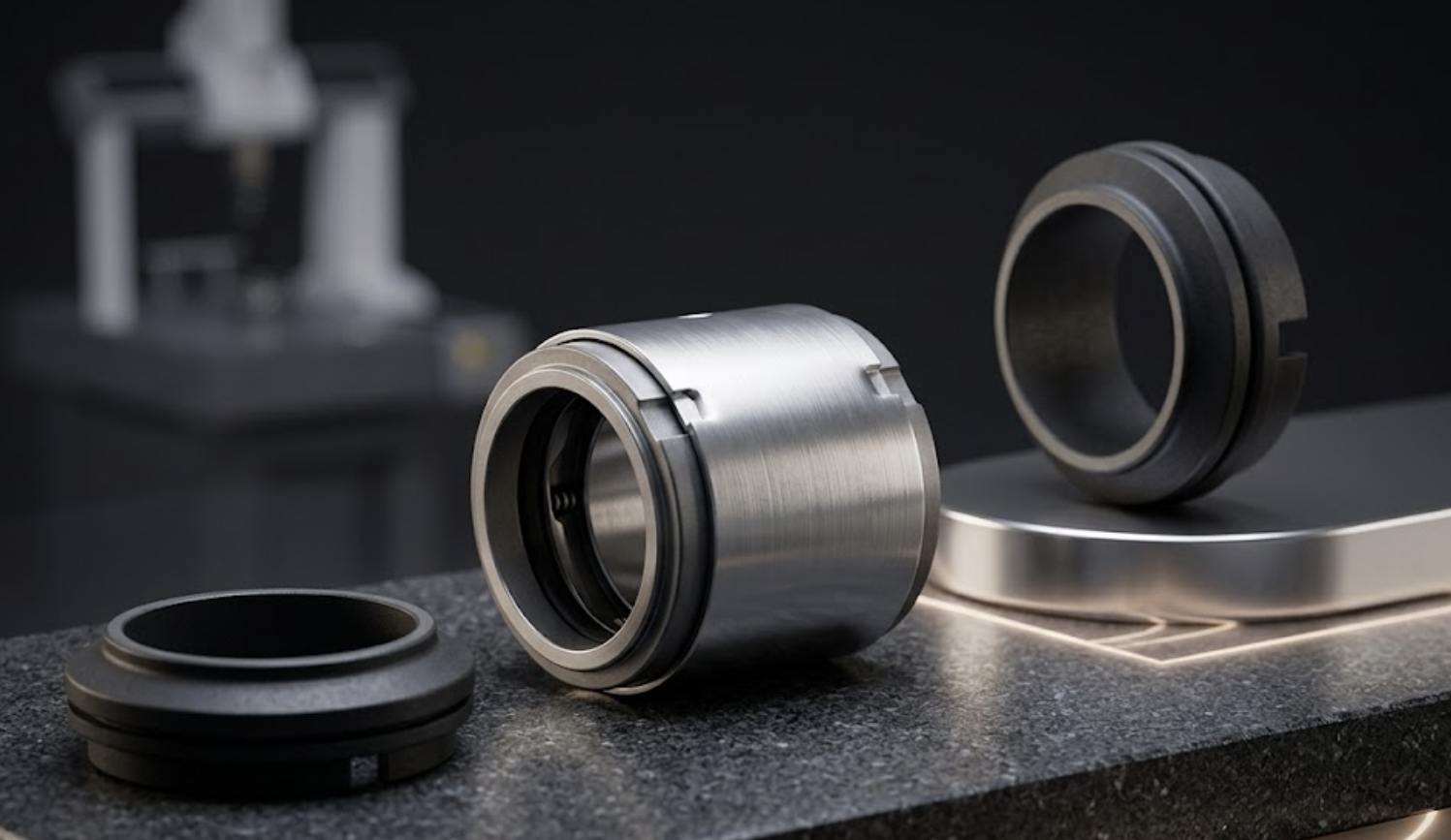
Ningbo, Zhejiang Sep 10, 2026 (Issuewire.com) - Managing high-speed rotary machinery requires a comprehensive understanding of complex tribological interactions at the sealing interface. Industrial operators constantly balance the dual demands of preventing fluid leakage and minimizing ongoing mechanical wear. To achieve this equilibrium, engineering teams must maintain precise face pressure control across the mating rings. If the face pressure drops too low, process fluids quickly breach the boundary layer and cause external emissions. Conversely, excessive face pressure accelerates friction, leading to premature face destruction and unplanned maintenance downtime. Traditional sealing systems frequently rely on a single large-coil spring to deliver the necessary axial force. However, these legacy single-spring designs introduce harmful parasitic tilting moments under high angular velocities, distorting the sealing gap. To eliminate such operational instability, modern rotary fluid-handling equipment adopts circumferentially distributed small spring clusters. Industrial operations achieve superior operational precision by collaborating with a specialized Custom Multi-Spring Oem Mechanical Seals Factory to obtain calibrated hardware. This strategic transition establishes an entirely uniform force distribution across the entire sealing plane, safeguarding critical chemical processes. Consequently, processing plants protect high-value rotary assets and ensure continuous compliance with strict global environmental emission frameworks. Sourcing managers actively prioritize these optimized component designs to protect overall facility runtime.
Hydrodynamic Film Kinematics: Balancing Elastic Loads with Fluid Micro-Films
The successful isolation of volatile process fluids depends entirely on the continuous stability of a microscopic liquid film between the rotating and stationary faces. This hydrodynamic fluid film typically maintains a thickness between 0.1 and 3 micrometers to ensure optimal lubrication. If the sealing faces experience any parallel distortion, this vital micro-film breaks down immediately, causing direct solid-to-solid contact. Therefore, the mechanical design must deliver a completely uniform elastic load to preserve this delicate micro-gap. A circumferential cluster of small springs achieves this goal by distributing the closing force across multiple geometric vectors. This multi-point loading effectively cancels out angular misalignment caused by sudden shaft wobble or high-frequency structural vibrations. As a result, the multi-spring layout greatly suppresses angular deflection and maintains near-parallel contact between mating seal faces during long-duration high-speed operation. Furthermore, this balanced configuration stabilizes the fluid dynamic film during sudden suction-side pressure spikes or fluid surges. When an industrial pump experiences volatile hydraulic profiles, the multi-spring array absorbs the resulting shock waves uniformly. This rapid mechanical response prevents temporary face separation and eliminates transient leakage during sudden process reversals. By maintaining a constant interfacial film, the system minimizes frictional torque and stabilizes energy consumption across the entire rotating assembly.
Metrology and Micro-Tolerances: How OEM Precision Controls Face Parallelism
Achieving perfect load uniformity requires exceptional manufacturing precision and rigorous metrology standards during every stage of component assembly. Standard mass-production techniques often yield minor variations in spring stiffness, which can compromise high-speed performance under pressure. Therefore, a premier manufacturer like GW SEAL(Ningbo Guowei Mechanical Seals Technology Co., Ltd) utilizes specialized automated testing equipment to measure and sort individual springs. The quality team ensures that every spring within a cluster exhibits an identical spring rate, eliminating mechanical imbalances. Additionally, technicians enforce strict geometric dimensioning and tolerancing guidelines for the stainless steel retainer cage. Machinists restrict perpendicularity and parallelism deviations to tight micrometer scales to eliminate uneven physical biases. If a retainer possesses even minor geometric flaws, the springs compress unevenly, creating localized force concentrations. These mechanical variances generate intense friction, leading to destructive thermal blistering on carbon-graphite or silicon carbide interfaces. By establishing uniform pressure across the entire face, the factory prevents these destructive hot spots from developing. This precise tolerance control directly extends the operating lifetime of alternative components in harsh chemical processing environments.
Engineering Stability Under Pressure: The GW SEAL H75 Balanced Architecture
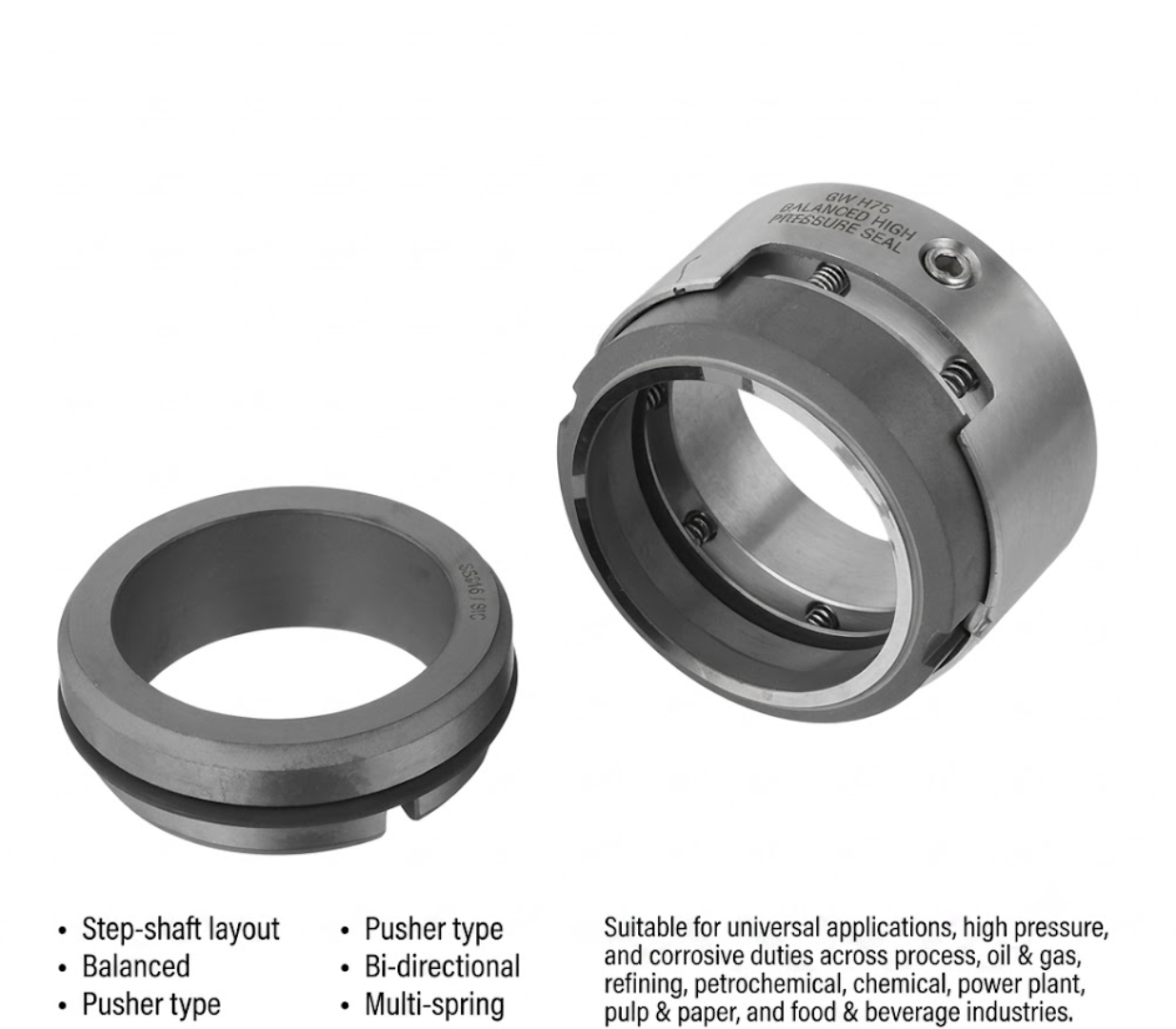
Demanding industrial processing environments require advanced structural configurations to withstand high rotational speeds and extreme fluid pressures. To address these critical conditions, engineering teams rely on the specialized parameters of the H75 balanced multi-spring mechanical seal. Engineered as a high-performance Burgmann H75 replacement, this robust architecture from GW SEAL is purpose-built to deliver maximum stability in elevated pressures high-velocity chemical processing loops.
Unlike unbalanced designs where face loading spikes drastically as system pressure rises, the H75 features a meticulously calculated hydraulic balance ratio. This engineering design decouples the primary sealing faces from volatile pipeline pressure fluctuations, preserving the integrity of the hydrodynamic fluid micro-film even during intense hydraulic surges.
Furthermore, the integration of a circumferential multi-spring array ensures perfectly uniform axial force distribution across the entire mating plane, eliminating the parasitic tilting moments that destabilize legacy single-spring components. By nesting these high-alloy springs within a structurally balanced matrix, the H75 maximizes axial follow-up performance and dampens high-frequency shaft vibrations effortlessly. Its robust torque transmission design handles heavy duty cycles without inducing localized stress concentration. This advanced engineering allows industrial facilities to secure high-pressure containment as a direct drop-in replacement, avoiding expensive pump seal chamber alterations or shaft modifications. The resulting load uniformity guarantees a highly predictable, symmetrical wear rate, completely eliminating thermal hot spots and significantly extending the mean time between failures (MTBF) for critical rotating assets.
Advanced Metallurgy and Lapping Processes for Bespoke OEM Customization
Tailoring mechanical components for aggressive chemical environments demands a deep commitment to material science and advanced surface finishing. Standard steel springs quickly degrade when exposed to volatile acids, corrosive compounds, or caustic wash solutions. Therefore, the production facility implements advanced materials and features to resist environmental attacks and maintain elasticity. Engineers utilize premium corrosion-resistant alloys, such as Hastelloy C-276 or high-grade Inconel, to manufacture the spring clusters. These exotic metals undergo custom heat treatment processes to eliminate permanent set or stress relaxation over extended lifecycles. Furthermore, the factory employs precision diamond-lapping machinery to refine the surface topography of the sealing faces. Technicians utilize monochromatic helium light waves and optical flats to verify face flatness within 3 helium light bands. This optical audit guarantees that the mating surfaces exhibit near-perfect flatness before leaving the assembly line. The specialized technical division customizes spring counts, wire diameters, and pitch circles for specific industrial fluid handling parameters. This bespoke tuning ensures optimal tribological performance, reducing starting torque and preventing particle shedding during continuous operations.
Conclusion: Upgrading Rotary Reliability through Calibrated Load Uniformity
Standardizing component specifications around calibrated multi-spring load uniformity represents a major milestone for modern industrial asset management programs. By replacing erratic single-coil springs with factory-calibrated clusters, operations teams effectively eliminate asymmetric face wear and localized thermal stress. This engineering upgrade secures long-term boundary layer stability, ensuring zero-emission compliance in volatile processing environments. Investing in verified geometric tolerances and premium corrosion-resistant alloys significantly lowers total operational expenditure across rotating equipment networks. Ultimately, choosing calibrated multi-spring configurations allows manufacturing plants to optimize process reliability and maximize mean time between failures. Maintenance supervisors and rotating equipment engineers can explore full dimensional blueprints and request tailored performance data from GW SEAL (Ningbo Guowei Mechanical Seals Technology Co., Ltd). Discover the complete portfolio of precision-engineered industrial fluid isolation systems by visiting the official corporate website at https://www.gwseal.com/.
Media Contact
Ningbo Guowei Mechanical Seals Technology Co., Ltd *****@mechanicalseals-china.com +86 574-88241891 4th Floor, Building 31, Intelligent Manufacturing Industrial Park, Heyicun, Jiangshan Town, Yinzhou District, Ningbo, Zhejiang, China https://www.gwseal.com/