
Jinan, Shandong Feb 13, 2026 (Issuewire.com) - The global energy landscape is currently undergoing a structural transformation. As nations strive to meet ambitious net-zero targets, biomass has transitioned from an auxiliary fuel source to a primary base-load energy provider. This shift requires industrial equipment that can handle massive throughput while maintaining strict energy density standards. In this context, the role of a China Leading Biomass Pellet Machine Factory becomes central to the international supply chain. Manufacturers like BISON MACHINE, formerly known as Hualong Machine Factory, exemplify this evolution. Based in Jinan, Shandong, the company has spent over 25 years refining the science of dense forming. By integrating scientific research with advanced production, the organization has shifted from a regional equipment maker to a global system integrator. This growth reflects a broader trend where technical depth and specialized engineering define success in the renewable energy market.
The Macro Evolution of the Global Energy Transition
For decades, biomass was often viewed as a localized solution for heating or small-scale waste management. However, modern energy markets now demand large-scale, reliable feedstock that can replace coal in thermal power plants. This transition necessitates a move away from generic machinery toward highly specialized systems. A factory with a 25-year heritage understands that consistency is the most valuable commodity in energy production. BISON MACHINE has navigated this change by continuously adopting advanced technology to meet shifting international requirements.
The transition from a factory focused on simple fabrication to one led by research and development marks a significant milestone. Today, the company specializes in turnkey solutions for medium and large-scale biomass pellet production lines. This multi-sector expertise allows for a more holistic approach to system design. By focusing on the entire lifecycle of the biomass material, the manufacturer helps drive the success of users worldwide. This strategic focus on sustainable development has facilitated exports to Southeast Asia, Europe, Africa, and the Americas. The ability to maintain quality across such diverse markets highlights the maturity of China’s high-end manufacturing sector.
Technical Solutions for Regional Raw Material Challenges
One of the primary obstacles in global biomass production is the inherent variability of raw materials. Different wood species possess unique cellular structures, moisture levels, and lignin contents. For example, eucalyptus is characterized by high oil content, whereas cedar features high fiber toughness. A leading factory must apply sophisticated R&D to adjust compression ratios for these specific materials. Without precise engineering, the pellets may lack the necessary durability for long-distance transport or fail to meet combustion standards.
In specialized production lines for eucalyptus and cedar, the engineering team must optimize the die design to ensure efficient dense forming. High-oil materials like eucalyptus require specific cooling and pressure parameters to prevent scorching during the extrusion process. Conversely, the toughness of cedar necessitates heavy-duty rollers and optimized ring die hole configurations to achieve high density. By mastering these variables, a professional manufacturer ensures that regional forestry waste becomes a high-value energy asset. This technical adaptability allows energy projects to utilize local resources effectively, reducing logistics costs and improving the overall carbon balance.
Systems Engineering for Ultra-Large-Scale Clusters
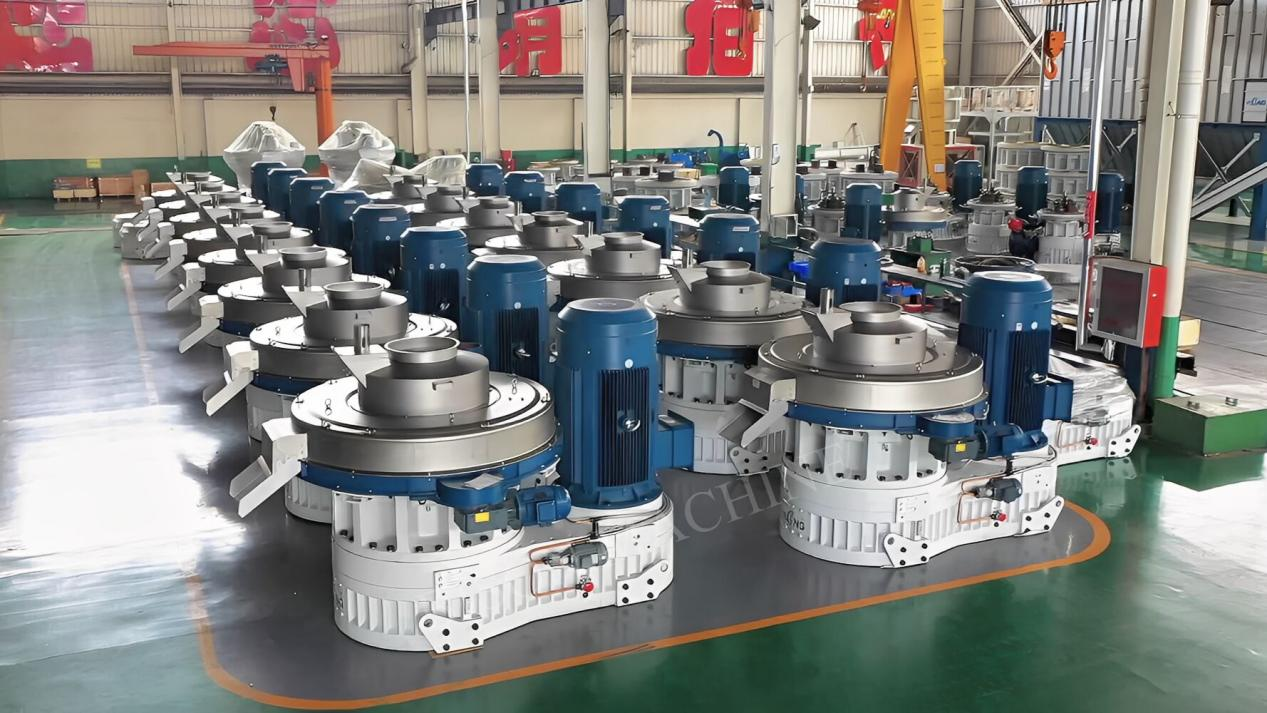
As the industry scales up, the demand for "matrix layouts" or machine clusters has grown. Large-scale industrial operations now require multiple pellet mills to work in perfect synchronization. A prominent example of this is the biomass pellet line in Thailand, which utilizes six 850-model pellet mills. In such a high-capacity environment, the stability of the entire system is only as strong as its weakest link. Engineering these clusters requires a deep understanding of load distribution and centralized control.
The Wood Pellet Machine units in these large installations must feature modular designs that allow for easy maintenance without interrupting the entire line. A matrix layout ensures that if one machine requires a die change, the other five units continue to produce at full capacity. Furthermore, centralized lubrication and monitoring systems reduce the labor intensity of managing such a vast facility. This industrial-scale approach satisfies the rigorous demands of multinational energy giants who require guaranteed uptime and consistent caloric output. By providing these complex system architectures, the factory demonstrates its capability as a global infrastructure partner.
Value Chain Integration and Operational Excellence
The growth of a leading manufacturer is often defined by its ability to move beyond individual machine sales into comprehensive systems engineering. For industrial users, the viability of a project depends not just on the pellet mill, but on the seamless integration of the entire production line—from raw material pretreatment to final packaging. BISON MACHINE’s expertise in providing turnkey solutions represents a strategic advantage, ensuring that every component, including specialized crushers, high-efficiency dryers, and automated cooling systems, is perfectly synchronized.
Efficiency in large-scale production is a result of this holistic system design. When the entire process—from moisture control in the drying phase to the precision of the pelletizing density—is engineered as a single cohesive unit, the system achieves higher operational stability and lower energy consumption per ton. This synergy reduces mechanical wear and minimizes dust emissions, which in turn lowers maintenance costs and extends the service life of the equipment. By focusing on the total performance of the production plant, the manufacturer helps clients optimize their return on investment (ROI) and remain compliant with increasingly strict global environmental and carbon regulations.
Conclusion and Future Outlook for Global Trust Standards
The 25-year journey of BISON MACHINE reflects the broader trajectory of the Chinese biomass energy sector. By prioritizing excellent service and technical accumulation, the company has helped define a new standard of trust for "Made in China" equipment. It is no longer just about manufacturing volume; it is about the precision of the engineering and the reliability of the global support network. This commitment to quality ensures that the investment in biomass infrastructure yields returns for decades.
As the energy shift continues to accelerate, the demand for specialized, high-capacity systems will only increase. Factories that can integrate scientific research with practical production will lead the next generation of renewable energy projects. By focusing on sustainable development and continuously updating their technical capabilities, these manufacturers provide a solid foundation for the global energy transition. The future of biomass energy lies in the hands of those who can bridge the gap between raw biological waste and high-efficiency thermal power.
For more information regarding advanced biomass production systems and technical specifications, please visit the official website: https://www.bisonpelletmachine.com/.
Media Contact
SHANDONG BISON MACHINE CO., LTD. inquiry@sdbison.cn https://www.bisonpelletmachine.com/