
Hangzhou, Zhejiang May 6, 2026 (Issuewire.com) - The global apparel manufacturing industry is undergoing a significant transformation as brands and factories pivot toward lean production models to combat rising material costs and environmental concerns. In this context, the efficiency of the cutting room has become a primary metric for operational success. Traditional manual or fragmented cutting processes often result in substantial fabric loss, which directly erodes profit margins and increases the carbon footprint of production. As a Leading Supplier of Integrated Cutting Systems for Clothing Factories, IECHO provides high-precision digital solutions designed to address these inefficiencies. By analyzing the role of integrated cutting systems in reducing material waste, it becomes clear that technical innovation in automation is no longer a luxury but a fundamental necessity for modern garment production.
The Systematic Impact of Digital Precision on Material Yield
To effectively reduce waste, a manufacturer must address the cutting process not as a single action, but as a multi-stage technical workflow. Integrated systems optimize this workflow through three primary pillars: software intelligence, mechanical execution, and structural adaptability.
1. Optimization of Fabric Utilization Through Intelligent Nesting
One of the most critical challenges in apparel production is "nesting"—the arrangement of pattern pieces on a roll of fabric. Even a 1% increase in fabric utilization can result in thousands of dollars in annual savings for a medium-sized factory. Integrated systems utilize advanced algorithms to calculate the most efficient layout, significantly reducing the "gap" waste between components. Unlike manual methods, digital nesting can process thousands of permutations in seconds to find the absolute mathematical limit of fabric density.
2. Precision Execution and High-Frequency Cutting Technology
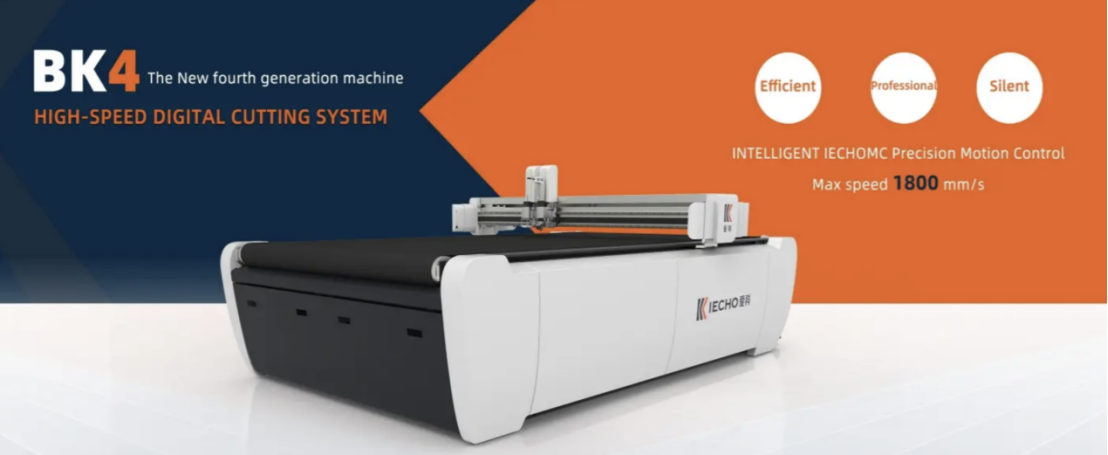
Beyond software optimization, the physical execution of the cut determines the final yield. Mechanical errors, such as over-cutting at corners or blade deflection in thick material layers, often lead to rejected parts. The BK4 High-Speed Digital Cutting System, the latest generation developed by IECHO, utilizes an enhanced intelligent cutting platform and precision compensation algorithms to ensure that the blade follows the digital path with sub-millimeter accuracy. This level of precision allows for tighter nesting patterns that manual cutters simply cannot achieve, effectively maximizing every inch of raw material.
3. Technical Parameters of the BK4 System
To understand how integrated systems minimize waste, one must examine the specific technical parameters that drive their performance:
- Cutting Stability and Versatility: The BK4 features a newly reinforced frame structure and an upgraded cooling system, allowing for sustained high-intensity production. By maintaining absolute vertical accuracy through its rigid gantry design, it eliminates the "tapering" waste common in older mechanical cutters, ensuring the bottom layer is as perfect as the top.
- Motion Control and Speed:The system boasts a superior maximum cutting speed of 1800mm/s and optimized acceleration rates. This is managed by an advanced multi-axis motion control system that prevents material bunching or stretching—a frequent cause of dimensional errors and subsequent scrap in high-speed operations.
Structural Integration: Bridging Design and Physical Production
The true power of an integrated cutting system lies in its ability to bridge the gap between design and physical production. In a fragmented workflow, pattern data often loses fidelity as it moves from the CAD (Computer-Aided Design) software to the cutting table. An integrated ecosystem ensures that the digital "source of truth" remains intact.
The BK4 industrial solution incorporates high-definition vision systems and automated feeding modules. For example, high-definition CCD cameras can identify fabric patterns or stripes, automatically adjusting the cutting path to ensure perfect alignment. This "vision-based cutting" is essential for high-end apparel where pattern matching is required. By automating this alignment, factories remove the human error associated with manual positioning, which is historically one of the largest sources of fabric waste in the fashion industry.
Furthermore, the BK4’s modular tool head allows for rapid tool changes. Whether a project requires a rotary knife for woven fabrics or a punch tool for ventilation holes, the system can adapt without lengthy downtime. This flexibility reduces "set-up waste"—the material often used to calibrate machines between different production runs.
Real-Time Data Analysis and Process Refinement
A critical yet often overlooked aspect of waste reduction is the ability to monitor and refine the cutting process through real-time data feedback. Integrated systems serve as a central nervous system for the cutting room, capturing granular performance metrics that were previously invisible to management.
By integrating IoT (Internet of Things) capabilities, these systems track the relationship between specific fabric types and cutting parameters. If a particular textile exhibits unexpected fraying or shrinkage, the system can adjust the blade speed or pressure dynamically. This proactive adjustment prevents the generation of bulk scrap that typically occurs when traditional machines are left to run with suboptimal settings. Furthermore, the ability to store and recall "cutting profiles" for specific materials ensures that the highest standard of efficiency is maintained across different shifts and production lines, creating a standardized environment where waste is minimized by design rather than by chance.
Strategic Conclusion for Modern Apparel Manufacturing
The role of integrated cutting systems in the apparel industry continues to evolve with the advent of AI-driven predictive maintenance and cloud-based production monitoring. As the industry moves toward "on-demand" manufacturing and smaller batch sizes, the ability to switch between designs rapidly while maintaining zero-waste protocols will define the market leaders.
Systems that combine high-speed hardware with intelligent software optimization are the cornerstone of this new industrial era. Through the combination of advanced motion control, intelligent nesting, and robust hardware design, systems like the IECHO BK4 enable factories to achieve a level of material efficiency that was previously impossible. For companies looking to maintain a competitive edge in a resource-constrained world, investing in these integrated solutions is a strategic imperative.
For more information on digital cutting solutions and technical specifications, please visit the official website: https://www.iechocutter.com/
Media Contact
Hangzhou IECHO Science & Technology Co., Ltd. info@iechosoft.com