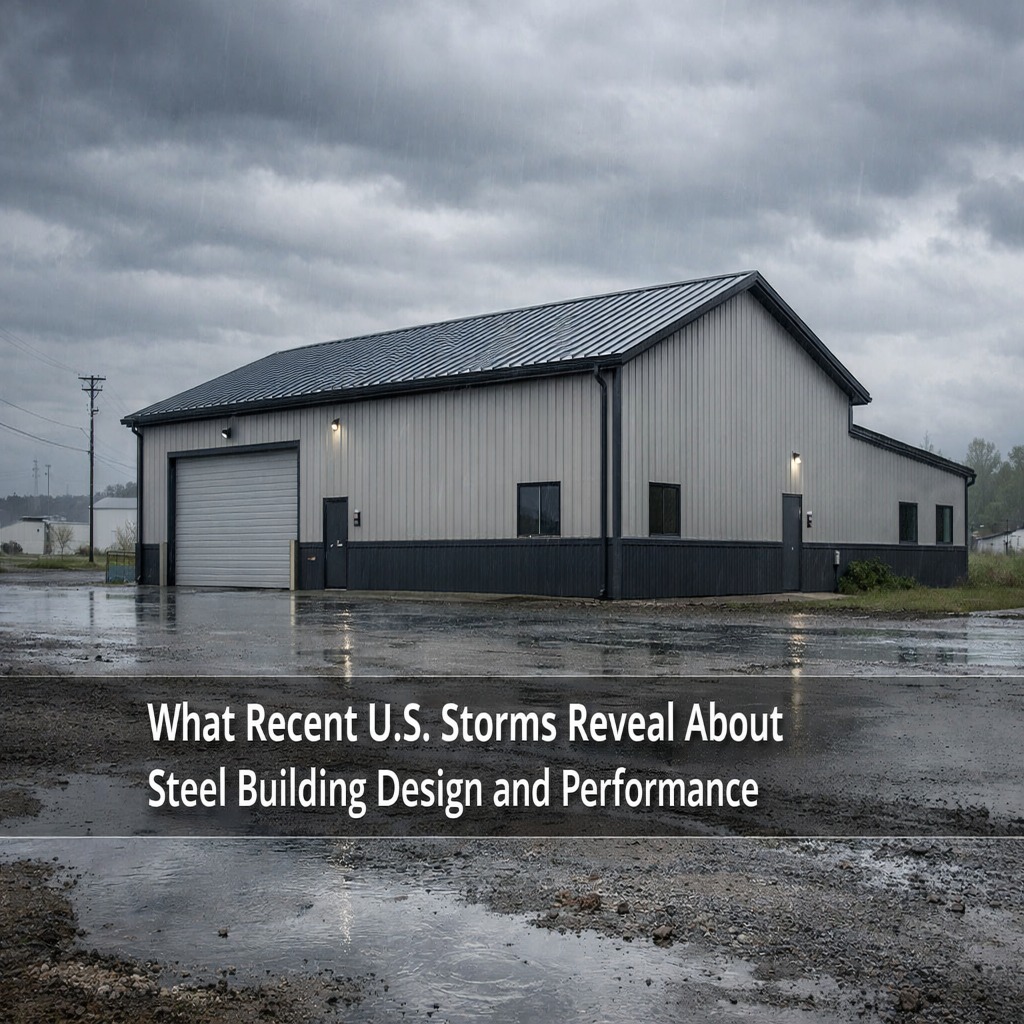
Winston-Salem, North Carolina Jan 29, 2026 (Issuewire.com) - American Metal Buildings (AmericanMetalBuildings.com) works with pre-engineered metal building packages nationwide. The last few severe U.S. storms have been a reminder that buildings don’t fail in theory—they fail at connections, corners, and foundations, where real loads show up first.
Over the past couple of years, the U.S. has seen a steady drumbeat of severe weather: long-track tornado outbreaks across the Plains and South, hurricane landfalls and inland wind events, lake-effect snow that loads roofs for days, and hailstorms that can turn a parking lot into a claims adjuster’s office. Every time one of these events hits, the news footage looks familiar—roofs peeled back, wall panels scattered, power lines down, a mix of buildings that made it through and buildings that didn’t.
From a construction standpoint, these storms are more than headlines. They’re real-world stress tests.
Steel buildings, especially pre-engineered metal structures, often come out of these tests looking better than the public expects. But when metal buildings do fail, the reasons are usually not mysterious—and they rarely have to do with “steel not holding up.” Most problems trace back to design shortcuts, poor load-path decisions, or anchoring and foundation work that didn’t match what the plans assumed. The storm simply exposes it.
Storms Don’t Break Buildings; They Find the Weak Links
A severe wind event doesn’t apply pressure like a gentle shove. It hunts. Wind gets under overhangs, pressurizes interiors through a failed door or a broken window, and starts prying at edges and corners where suction forces are highest. Hail doesn’t “damage a roof” in the abstract; it tests the toughness of roof coverings and the detailing around penetrations. Snow doesn’t just add weight; it adds uneven weight—drifts, sliding, melt-freeze cycles, and that heavy, wet stuff that arrives when you least want it.
That’s why storms are such useful diagnostics. You can review drawings all day, but a real event tells you whether the building had redundancy, whether the load path was continuous, and whether connections were detailed and installed the way the engineer intended.
Why Properly Engineered Steel Buildings Often Perform Well
When a steel building is designed and detailed correctly, it has several advantages in severe weather. Steel framing is predictable. It doesn’t hide defects the way some materials can, and it doesn’t rely on “feel” during installation to achieve structural capacity. A properly engineered pre-engineered metal building (PEMB) is also a system—primary frames, secondary members, bracing, diaphragm action, and connections all intended to work together.
That systems approach matters in storms. Wind and snow loads don’t care whether your building is a warehouse, a farm shop, or a municipal facility. They care about stiffness, strength, and continuity. Steel performs well because it can deliver those qualities consistently—assuming the building is engineered to the local hazards and assembled accordingly.
I’ve walked sites after major wind events where the steel frame was still plumb and serviceable, even when the cladding was torn up. That’s not a “steel is magic” story. It’s a story about clear load paths and proper connection design. In many cases, the frame did its job; the building envelope took the hit, which is often a more manageable repair.
Most Failures Aren’t “Steel Failures.” They’re Load-Path and Detail Failures.
When a metal building suffers major damage, there’s usually a sequence. It starts with something small and local: a door that wasn’t wind-rated, a panel edge that wasn’t fastened per spec, a roof curb that wasn’t detailed for uplift, or an anchor issue at the base. Once that first breach happens, internal pressure rises, uplift increases, and the event escalates.
Three patterns show up repeatedly in storm-related damage:
1) Design shortcuts that ignore local load requirements.
The U.S. has wide regional variation in wind speeds, exposure categories, snow loads, and special conditions like topographic wind effects or drifting snow. A “standard” building that isn’t specifically engineered for its site is a gamble. In practice, that gamble often shows up in under-designed roof systems, insufficient bracing, or endwall detailing that can’t handle suction and racking loads.
2) Improper anchoring and foundation mismatches.
You can have a perfectly designed superstructure sitting on a foundation that doesn’t provide the assumed resistance. Anchor bolt size, embedment, edge distance, and placement tolerance matter. So do slab thickness, pier dimensions, and the soil conditions they’re bearing on. I’ve seen cases where anchor bolts were “close enough” until a wind event proved they weren’t. The building didn’t fail because it was steel. It failed because the connection to the ground wasn’t what the design required.
3) Envelope and connection details that were value-engineered too far.
Fastener schedules, panel gauge, clip spacing, and diaphragm requirements are not optional suggestions. They’re part of how wind-rated structures work. Skipping fasteners, substituting components without engineering review, or treating trim and closures as cosmetic can turn the edge of a roof into the start of a progressive failure. The failure might look dramatic, but it often begins with something unglamorous: a missing stitch screw at a sidelap, a mis-installed eave detail, or a roof penetration that wasn’t flashed and reinforced properly.
Wind Ratings Aren’t a Marketing Spec; They’re a Performance Baseline
In metal building design, wind rating should be treated the same way you treat a foundation bearing capacity: as a baseline requirement, not a “nice to have.” That starts with correct site classification—Exposure B vs. C is not a minor detail—and continues through enclosure classification (enclosed, partially enclosed) and proper internal pressure coefficients. A building with a large overhead door is a different animal than a fully enclosed structure, and the detailing should reflect that reality.
Practically, the most storm-resilient steel buildings I’ve been around share a few traits: clear bracing layouts, robust endwall design, attention to corner and edge zones on the roof, and connections that were installed the way the drawings intended—not “field modified” to save an hour.
Roof Systems: Where Storm Performance Is Won or Lost
In severe weather, roofs take the first punch. Uplift is highest at edges and corners. Hail targets the surface. Snow creates sustained gravity load and drift load that can exceed what people assume by looking at a weather app.
For steel buildings, that makes the roof system—purlins, clips, deck/panels, insulation, and fastening pattern—a primary determinant of storm performance. A well-designed roof isn’t just strong; it’s detailed to avoid progressive failure. That means appropriate panel selection for the region, tested/verified assemblies where needed, and real attention to penetrations and equipment curbs. In my experience, the buildings that “mysteriously lost the roof” in wind often had a predictable story once you looked closely at the edges, penetrations, and fastening.
Regional Engineering Isn’t Red Tape. It’s Risk Management.
One of the quiet takeaways from recent storms is that the code landscape is getting less forgiving. More jurisdictions are adopting newer building codes and more current ASCE wind and snow provisions, and insurers are paying closer attention to loss history. That’s not an argument for overbuilding. It’s an argument for correctly building.
When metal building design is done with local conditions in mind—wind speeds, exposure, snow drift, hail-prone regions, coastal corrosion environments—the end product tends to behave rationally during severe weather. When those realities are ignored, the building may look fine until the day it doesn’t.
What the Storm Footage Doesn’t Show
After a storm, people understandably focus on what failed. But the more useful question is what stayed standing and why.
In many severe weather events, properly engineered steel buildings remain structurally intact, even when surrounding components and adjacent structures are heavily damaged. That’s the difference between a building that was designed as a complete system and one that was treated as a kit of parts. Storm performance isn’t luck. It’s engineering, detailing, and execution.
And the hard truth is that most dramatic failures are preventable. They’re not a condemnation of steel buildings. They’re a reminder that wind-rated structures only perform as well as the decisions made at design, foundation, and installation.
Media Contact
American Metal Buildings americanmetalbuildingsinc@gmail.com 13362342885 800, Piedmont Triad West Dr. Suite D https://www.americanmetalbuildings.com/