
Boston, Massachusetts May 22, 2026 (Issuewire.com) - Accelerating Drug Discovery with AI and Next-Generation Automation
The pharmaceutical industry is currently witnessing a transformative shift as the traditional, trial-and-error approach to drug development gives way to a more data-driven and automated paradigm. At the forefront of this evolution is the emergence of the Advanced Small Molecule Drug Discovery Technology Platform, a comprehensive ecosystem that leverages the latest advancements in computational science and laboratory robotics to redefine how new medicines are brought to life.
The Evolution of Small Molecule Drug Discovery
Small molecule drugs remain the backbone of the global pharmaceutical market due to their predictable pharmacokinetics and ease of administration. However, the journey from a biological target to a preclinical candidate (PCC) is notoriously complex, often taking over five years and costing billions of dollars. The primary bottleneck lies in the vastness of the chemical space—estimated at 10 to the power of 60 possible drug-like molecules—which makes traditional experimental screening methods inefficient and resource-intensive.
To address these systemic inefficiencies, the industry is increasingly turning to integrated solutions that bridge the gap between "dry lab" (computational) predictions and "wet lab" (experimental) validation. This hybrid approach enables the efficient exploration of expansive chemical spaces, identifying novel molecular structures while focusing on the synthesis of fewer but strategically selected compounds. This strategy not only enhances innovation but also significantly reduces the time and resource investment required to deliver promising hits and leads.
Empowering Drug Discovery Journey from Target to Preclinical Candidate with AI
How AI Accelerates the Journey from Target to PCC
The core advantage of an AI-driven platform is its ability to accelerate the end-to-end small molecule drug discovery process through a seamless integration of different technological layers. The process begins with target identification and moves rapidly through lead optimization to preclinical candidate nomination.
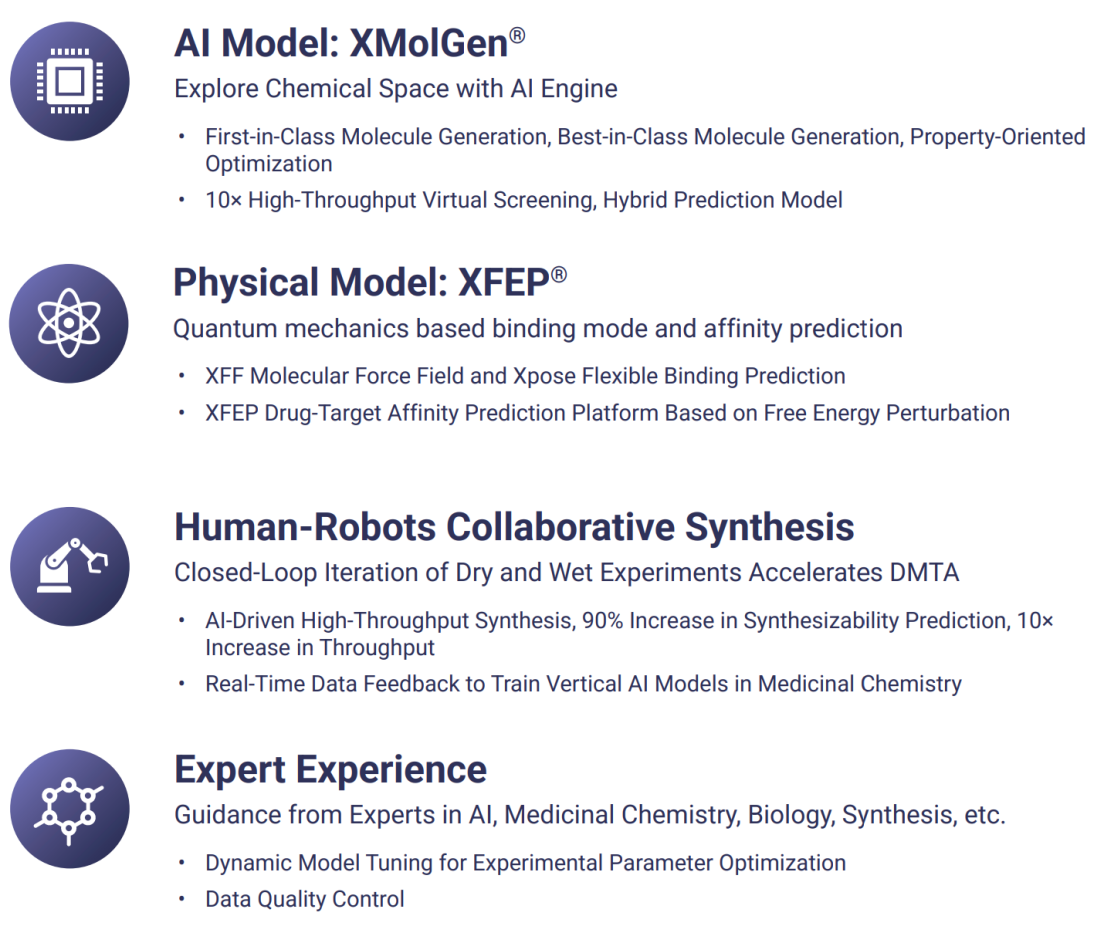
How can AI accelerate this entire journey? It does so by creating a closed-loop system where data flows continuously between virtual models and physical experiments. In the early stages, AI engines like XMolGen are used to explore the chemical space, generating first-in-class and best-in-class molecule candidates with property-oriented optimization. These models can perform high-throughput virtual screening and hybrid prediction at speeds unattainable by human researchers.
By utilizing large-scale cloud computing architecture—which provides global million-peak CPU core scheduling—AI models can calculate molecular properties and binding affinities with high precision. This computational foundation ensures that by the time a compound is selected for physical synthesis, there is already a high level of confidence in its potential efficacy and safety.
Addressing Critical Problems in Small Molecule Drug Discovery
Classical early-stage drug design remains constrained by low structural predictability and biased chemical libraries, which inherently elevate preclinical failure risks. Advanced platforms are now specifically designed to mitigate these risks:
Target Validation and Binding Mechanisms. One of the earliest hurdles is understanding how a molecule interacts with its target. Platforms now integrate structure validation and binding mechanism analysis using techniques such as Cryo-EM. By combining these structural insights with quantum mechanics-based binding mode predictions, researchers can achieve a level of detail that informs better molecular design.
De Novo Design and Virtual Screening Rather than simply screening existing libraries, AI enables de novo design—building molecules from scratch to fit specific biological "pockets". AI-powered virtual screening and molecule generation platforms like XMolGen allow for scaffold hopping and compound enumeration that expand the diversity of the chemical leads.
ADMET Optimization A common reason for clinical failure is poor ADMET (Absorption, Distribution, Metabolism, Excretion, and Toxicity) properties. XtalPi utilizes over 200 AI models covering druggability and physicochemical analysis to predict these outcomes early in the cycle. This early-stage profiling allows for property-oriented optimization, ensuring that only the most viable candidates proceed to the lead stage.
Synthetic Route Design: Even the most promising molecule is useless if it cannot be synthesized. Modern AI platforms provide a 90% increase in synthesizability prediction accuracy. By coupling AI with medicinal chemistry expertise, these systems design efficient synthetic routes that can be executed by robotic workstations, significantly increasing throughput.
The Power of AI and Robotics Coupling
Founded in 2015 by three MIT-trained physicists, XtalPi has established itself as a pioneering technological platform company at the intersection of quantum physics, artificial intelligence (AI), and advanced robotics. By prioritizing sustained innovation in chemical discovery, the company is addressing the fundamental challenges of modern R&D, providing a unified ecosystem to accelerate molecular breakthroughs across a wide range of industries, from biopharmaceuticals to new materials.
A unique feature of the current technological landscape is the "AI + Robotics" coupling. This is not merely about automating manual tasks but about creating a "Dry/Wet Lab Iteration Cycle". In this model, real-time data from automated robotic synthesis and bioactivity validation is fed back to train and refine vertical AI models.
XtalPi operates more than 10,000 square meters of laboratory facilities equipped with over 300 automated robotic workstations. These facilities handle everything from chemical synthesis to antibody and formulation development. This large-scale automation leads to a 10x increase in synthesis throughput, allowing for rapid iterations of the Design-Make-Test-Analyze (DMTA) cycle. By automating the "Make" and "Test" phases, the platform ensures high data quality control and dynamic model tuning, which are essential for medicinal chemistry success.
Core Technologies and Platform
XtalPi's proprietary AI-driven drug discovery platform seamlessly integrates the efficiency of AI with the precision of physics-based computational models. This hybrid approach enables the efficient exploration of expansive chemical spaces, identifying novel molecular structures. By focusing on the synthesis of fewer but strategically selected compounds, the platform enhances innovation while significantly reducing time and resource investment, delivering a more efficient path to promising hit, lead and preclinical candidate (PCC) compounds:
- XMolGen (AI Model): An engine for exploring chemical space and generating optimized molecules.
- XFEP (Physical Model): A drug-target affinity prediction platform based on Free Energy Perturbation and quantum mechanics. It uses the XFF Molecular Force Field for high-precision binding predictions.
- PatSight(Patent and SAR Landscaping): Tools like PatSight help researchers navigate the intellectual property landscape and Structure-Activity Relationship (SAR) data.
- Molecular Profiling: Comprehensive assessment of physical properties and druggability.
- Experimental Support Core: Providing high-throughput screening and bioactivity validation to support the digital predictions.
- Expert Experience: Guidance from Experts in AI, Medicinal Chemistry, Biology, Synthesis, etc.
These technologies are delivered through flexible service models, supporting pharmaceutical companies at any stage of their journey—whether they need a specific modular service or a complete end-to-end solution from target to PCC.
A Global Research Powerhouse
The impact of these technological advancements is reflected in the corporate growth of the sector. In June 2024, XtalPi achieved a landmark listing on the Hong Kong Stock Exchange (HKEX:2228), becoming the inaugural Chapter 18C-listed specialized technology company. This milestone underscores the market's confidence in the role of AI and robotics in driving industrial innovation.
With operational bases in Boston, Liverpool, and other cities, the company maintains a global footprint that allows it to serve industrial giants and emerging biotech firms alike. The workforce is heavily research-oriented, with personnel specializing in IT, medicinal chemistry, biology, and physics-based modeling constituting over 70% of the staff. This concentration of expertise ensures that the AI models are guided by real-world experimental insights and professional experience.
Conclusion
The integration of AI, quantum physics, and robotics is no longer a futuristic concept but a present-day reality that is actively shortening timelines and reducing costs in drug discovery. By focusing on high-quality data, physics-based accuracy, and large-scale automation, platforms like XtalPi are providing the "Computing Foundation" and "Experimental Core" necessary for the next generation of life sciences innovation. As investment in these digital and hardware infrastructures continues to grow, the path from a biological hypothesis to a life-saving preclinical candidate will become increasingly efficient, ultimately benefiting patients worldwide.
For more information on the future of AI-driven research and development, please visit: https://en.xtalpi.com/
Media Contact
XtalPi bd@xtalpi.com