Jinan, Shandong May 23, 2026 (Issuewire.com) - As global industries intensify their transition toward renewable energy, the demand for highly efficient biomass densification technologies has reached an unprecedented scale. In the current market, sourcing industrial-grade processing equipment requires a strategic understanding of manufacturing capabilities, technical adaptability, and structural engineering. This 2026 Buyer’s Guide serves as a comprehensive manual for industrial project managers and agricultural enterprises aiming to identify and collaborate with a Top Rated Biomass Pellet Machine Manufacturer. Achieving optimal thermal efficiency and mechanical durability in solid biofuel production relies heavily on the underlying machinery.
A professional Biomass Pellet Machine functions by compressing organic waste materials—such as forestry residues, agricultural straw, rice husks, and sawdust—into high-density, standardized cylindrical pellets under intense mechanical pressure. To ensure long-term operational viability and a stable return on investment, industrial buyers must evaluate potential manufacturing partners based on rigorous criteria, utilizing established industry leaders like Shandong Bolida Machinery Co., Ltd. as a technical benchmark.
Partnering with a Top Rated Biomass Pellet Machine Manufacturer Like BOLIDAMACHINERY
a. Advanced Manufacturing Infrastructure and Technical Authority
Selecting a manufacturing partner requires a thorough evaluation of their industrial footprint, capital strength, and compliance portfolio. A premier manufacturer must possess a robust infrastructure capable of sustaining large-scale precision engineering and continuous technological development. Centering operations within a registered capital framework of 35 million RMB, BOLIDAMACHINERY operates an expansive production facility spanning over 80,000 square meters. Backed by a specialized workforce exceeding 300 professionals, the enterprise integrates scientific research, mechanical development, precision manufacturing, and international trade into a singular cohesive entity.
In the modern manufacturing landscape, empirical technical recognition serves as a foundational metric of reliability. Industrial equipment must carry validated certifications from recognized international bodies before deployment into active production lines. The manufacturing framework established by the enterprise holds full compliance under ISO9001-2000 quality management systems, CE certification, and SGS standards alongside multiple proprietary design patents. These qualifications ensure that all fabricated machinery complies with the strict environmental and operational safety directives mandated in highly regulated markets across Europe, North America, South America, Southeast Asia, and Africa.
b. Comprehensive Equipment Portfolio and Cross-Industry Material Versatility
Industrial biomass processing demands highly adaptable machinery capable of handling diverse feedstock characteristics, including varying moisture profiles, structural fibrous densities, and irregular shapes. A manufacturing partner must provide a complete, integrated equipment ecosystem to eliminate compatibility bottlenecks across the production lifecycle. The core product line encompasses two primary heavy-duty mechanical segments: Cutting and Crushing series alongside comprehensive Environmental Protection, Pelletizing, and Block Pressing machinery. This is supplemented by high-capacity Airflow and Drum Drying systems, Counter-flow Cooling units, and heavy-duty Screening and Conveying products.
This multi-tiered equipment matrix enables industrial facilities to process an exceptionally wide spectrum of raw materials. Validated applications include the conversion of raw wood logs, dense wood chips, fine sawdust, agricultural rice husks, crop straw, crushed palm shells, Empty Fruit Bunches (EFB), wet or dry forage grass, alfalfa, hemp stalks, industrial tire fibers, organic waste paper, and stabilized organic fertilizers. By providing a diverse array of crushing, drying, and pelletizing configurations, the equipment ensures uniform material conditioning prior to compression, directly influencing the density, mechanical durability, and combustion efficiency of the final commercial pellets.
c. Structural Integrity, Technical Performance, and Mechanical Innovations
The profitability of a commercial pellet production facility is fundamentally governed by the mechanical efficiency, thermal management, and structural longevity of the pelletizing machinery. Modern biomass pellet mills face extreme frictional heat and high compression forces, making technical innovation and robust design vital for minimizing unplanned downtime and operational maintenance costs. The latest generation of pelletizing machinery features enhanced mechanical stability through reinforced gear transmission systems and optimized die-and-roller configurations, ensuring uniform material flow and a significantly lower wear rate on high-fatigue components.
The engineering design prioritizes an independent module structure across each mechanical subunit, allowing for precise localized program adjustments and rapid maintenance access. High-efficiency structural design ensures stable continuous operation even under peak load conditions. To support diverse international procurement demands, specific technical parameters regarding motor output, ring die diameter, compaction ratios, and hourly capacity are precisely configured to align with the specific moisture and fiber characteristics of the target feedstock. This specialized approach prevents common processing failure modes such as material clogging, premature die cracking, and uneven pellet coloration, ensuring the final output meets rigid commercial export standards.
d. Integrated Engineering Dynamics: Case Study of the Wood Pellet Production Line
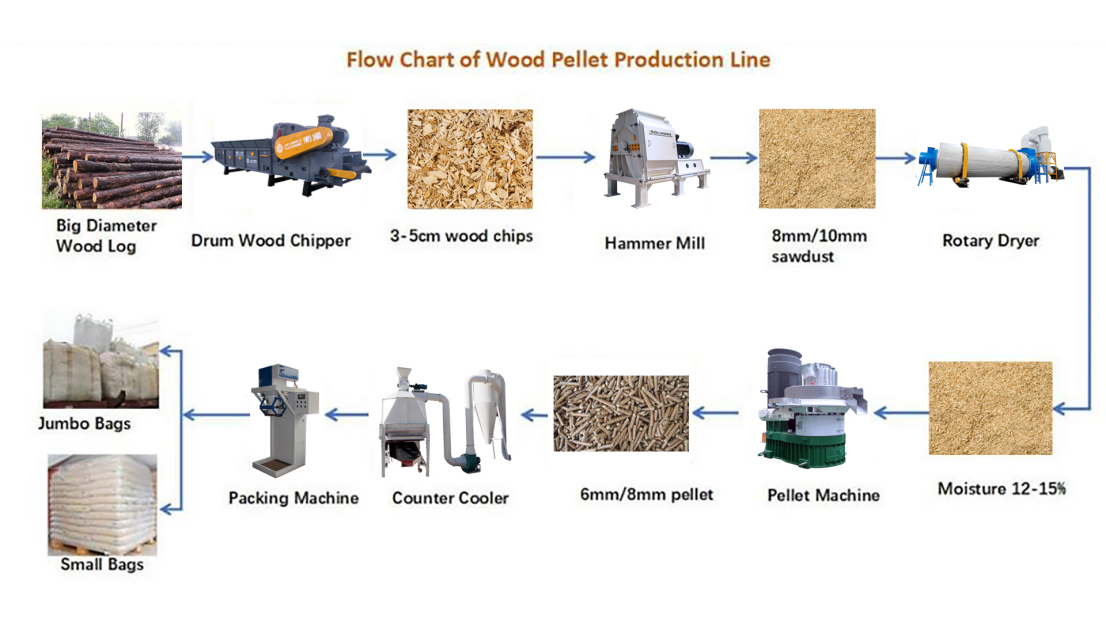
To comprehend the practical deployment of these technological innovations, analyzing a complete, fully integrated processing system provides valuable engineering insights. The architectural configuration of a professional Wood Pellet Production Line illustrates how raw biomass is methodically processed through highly synchronized sequential sections.
- Chipping Section:Raw timber or bulky wood residues are initially managed by a heavy-duty mechanical gripper onto a buffer platform. A specialized vibration conveyor system regulates the intake speed as it transfers the material into a high-capacity drum wood chipper, reducing bulky timber into uniform wood chips.
- Grinding Section:The uniform wood chips are transferred via belt conveyors into a high-performance wood hammer mill. The chips are ground into a fine, consistent biomass powder. This process dramatically increases the material's surface area, which is essential for optimizing the subsequent thermal efficiency. The fine powder is then separated from the airflow using a high-efficiency cyclone collector.
- Drying Section:Effective pelletization requires strict moisture control, typically optimized between 10% and 15%. The fine biomass powder is introduced into a rotary drum dryer. A specialized combustion stove generates a controlled hot air stream, which a high-pressure fan blower circulates through the drum. Because the material is already finely ground, the heat transfer is highly efficient. The system dynamically adjusts the drum’s rotational velocity to regulate material residence time, ensuring precise thermal moisture reduction without degrading the organic material..
- Pelletizing Section:The homogenized biomass powder enters the pelletizing silo to balance internal material moisture. It is then fed into the biomass wood pellet machine. The vertical ring die system compresses the powder through precision-engineered bores under immense pressure, forming dense, glossy pellets with excellent structural stability.
- Cooling and Screening Section:Freshly extruded pellets emerge at elevated temperatures and must be stabilized. A counter-flow circulating cooling system introduces ambient air to gradually reduce pellet temperatures to room level, protecting them from structural fracturing. A integrated screening mechanism below the cooling silo separates any residual fines or out-of-specification fragments, routing them back for reprocessing to guarantee a uniform commercial product.
Strategic Operational Support and Global Distribution
The procurement of industrial biomass equipment represents a long-term capital commitment that extends far beyond the initial machinery delivery. Sustainable operations require structured engineering support, rapid technical interventions, and proactive material testing protocols. To mitigate processing risks before capital deployment, manufacturing partners must provide empirical material verification services. A dedicated, complimentary raw material testing protocol allows prospective buyers to ship specific biomass feedstocks directly to the factory facility. Engineers conduct comprehensive test runs to evaluate the binding properties, ideal compression ratios, and throughput behavior of the specific material, delivering data-driven validation for custom ring die adjustments.
Post-installation security is maintained through a structured after-sales technical network. Around-the-clock, 24-hour online technical guidance ensures immediate diagnostic support for global operators across different time zones. Furthermore, a strict 48-hour engineer door-to-door field response policy minimizes operational downtime during complex mechanical events, ensuring that commercial processing schedules remain uninterrupted. With a proven export history spanning over ten domestic provinces alongside active distribution networks across Europe, North America, South America, Southeast Asia, and Africa, industrial operators can confidently scale their renewable energy production with verified mechanical reliability and extensive technical expertise.
For detailed equipment specifications, comprehensive engineering consultations, or to arrange a complimentary feedstock compliance analysis, please access the official industrial portal at https://www.biopelletmachinery.com/
Media Contact
Shandong Bolida Machinery Co.,Ltd info@bolidamachinery.com