Wenzhou, Zhejiang Apr 2, 2026 (Issuewire.com) - In steel structure construction, bridge engineering, heavy machinery manufacturing, and related fields, H-beams are indispensable core components. However, the conventional processing of extra-long H-beams (12m and above) often suffers from scattered processes, high labor dependency, and repeated handling between cutting and welding operations.
If your factory is looking for a robotic solution that seamlessly integrates cutting and welding and can reliably handle 12m H-beams, you need to understand the following technical trends and selection guidelines. This article provides a comprehensive selection guide for steel structure business owners, production managers, and technical decision-makers.
- Why Is an Integrated Welding & Cutting Robot the Inevitable Direction for H-Beam Processing?
Traditional H-beam production usually follows: raw material cutting → coped/flame cutting → assembly → welding → straightening → secondary processing (stiffeners, brackets, etc.). In this workflow, cutting and welding are often physically separated—the workpiece is lifted, transported, and re-clamped multiple times, leading not only to low efficiency but also cumulative positioning errors that directly affect final quality.
An integrated welding & cutting robotic workstation completely transforms this:
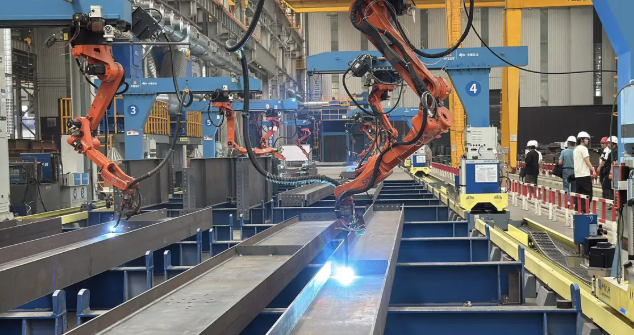
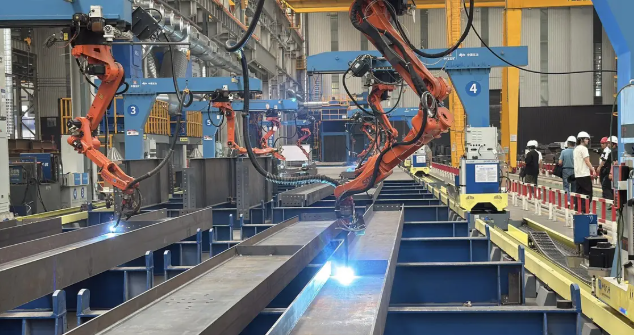
- One-time clamping, full process completion: The 12m H-beam is clamped only once; the robot sequentially performs plasma/flame cutting (beveling, coping, hole making) and robotic welding (stiffeners, brackets, auxiliary plates).
- Reduced work-in-process inventory: No need to store cut parts and welded parts separately; workshop floor space is saved.
- Consistent accuracy: Cutting and welding share the same reference datum, eliminating cumulative errors caused by different equipment and fixtures.
- Core Configuration of a 12m H-Beam Welding & Cutting Integrated Robot
For an H-beam as long as 12m, the reach of a standard industrial robot is insufficient. Therefore, integrated solutions typically adopt a “robot + external traveling axis” or a gantry / cantilever extension design.
2.1 Structural Types
Structure Type
Features
Suitable Scenarios
Cantilever Robot Workstation
The robot moves along a cantilever beam with a 12m+ guide rail underneath; it occupies less width and is convenient for overhead crane loading.
Long workpieces with moderate width; frequent model changes.
Gantry Robot Workstation
A gantry supported by two upright columns, carrying one or two robots; superior rigidity, ideal for heavy, extra-long workpieces.
High-volume production, heavy workpieces, where dual-robot cooperative welding improves efficiency.
2.2 Integrated Functions
- Cutting Unit: Equipped with aplasma cutting systemor fiber laser cutting head to perform coping, corner cutting, beveling, round/slot holes on the H- The cutting robot uses offline programming or vision positioning to accurately identify the web and flange positions.
- Welding Unit: AdoptsGMAW (MIG/MAG)with a laser vision sensor that tracks the seam in real time and automatically adapts to workpiece deformation.
- Intelligent Control System: Ateach-less programming systemthat directly imports 3D models (Tekla, SolidWorks, CAD), automatically identifies weld features, and generates robot paths and welding parameters—no manual programming required.
- Intelligent Technologies That Make the Equipment Truly Usable
Many companies invest in robots but end up leaving them idle because programming is complicated and changeover takes too long. An integrated machine for 12m H-beams must be equipped with the following smart technologies:
✅ Teach-less Programming
The system automatically reads the 3D model, identifies weld positions, bevel angles, and plate thickness, and then matches the appropriate welding current, voltage, and speed. When a new workpiece is introduced, the operator simply selects the model file; task configuration is completed within one minute, eliminating tedious point-to-point teaching.
✅ High-Precision Laser Seam Finding
H-beams are prone to thermal deformation after assembly and welding. Using a laser vision sensor (e.g., large-field-of-view seam finder), the robot scans the actual seam position before welding, achieving accuracy of ±0.05mm. The path is corrected in real time to ensure consistent weld quality.
✅ Process Database
The system comes with a built-in H-beam welding process package. For typical joints such as fillet welds between web and flange, butt welds on beveled edges, and stiffener fillet welds, optimal parameters are automatically applied—eliminating quality fluctuations caused by manual experience-based adjustments.
- Productivity Comparison: Integrated Robot vs. Traditional Method
Take a 12m H-beam (with 8 stiffener welds + coping cuts at both ends) as an example:
Item
Traditional Manual + Standalone Machines
Integrated Welding & Cutting Robot
Process Flow
Cutting → Transport → Fit-up → Welding, at least 4 lifts
One-time clamping, continuous processing
Operators
1 cutter + 2 welders + 1 assistant
1 technician for monitoring
Total Cycle Time per Piece
~2.5 hours
~0.8 hours
Changeover Time
Re-positioning and program adjustment ~1 hour
Teach-less, start within 5 minutes after loading new model
Weld Quality
Depends on welder skill, inconsistent
Robotic welding, uniform appearance, NDT pass rate >98%
The data shows that an integrated robot can increase overall efficiency by more than three times, reduce manpower by over 60%, and significantly lower dependence on skilled welders.
- Typical Application Example【Case】A Large Steel Structure Manufacturer
- Workpieces: 12m–14m H-beams, web height 400–800mm, flange width 200–400mm.
- Configuration:Cantilever 9-axis robotic welding & cutting workstationwith plasma cutting, dual-wire welding, and laser seam finding.
- Results:
- Cutting and welding processes reduced from3 operators/shiftto 1 operator/shift.
- Daily output increased from8 pieces/dayto 22 pieces/day.
- Position deviation caused by secondary clamping was completely eliminated; the final product pass rate reached5%.
Why Choose KEYGREE GROUP CO., LTD.?
As a technology-driven company specializing in the R&D and integration of intelligent H-beam processing equipment, KEYGREE GROUP CO., LTD. provides you with one-stop services from process planning and equipment manufacturing to installation, commissioning, and after-sales support.
Our Core Advantages
- Focus on Extra-Long Workpieces (12m+): All our systems are optimized for rigidity and accuracy when handling extra-long H-beams, ensuring traveling axis positioning accuracy ≤ ±0.1mm over the full stroke.
- Proprietary Teach-less System: Deeply adapted for the steel structure industry, it supports direct import of Tekla, CAD, and SolidWorks files without requiring third-party conversion software.
- Proven Components & Fast Delivery: Key components (laser sensors, servo systems, welding power sources) are sourced from top international brands, guaranteeing long-term reliability.
- Local Service: Nationwide after-sales network with 24-hour response, remote diagnostics, and on-site support.
What You Will Gain
- Anintelligent production line integrating welding and cutting, reducing process transfers and manual intervention.
- Flexible processing capabilityfor 12m, 14m, or even longer H-
- Significantly lowerunit costand lead time, enhancing your market competitiveness.
- Frequently Asked Questions (FAQ)
Q1: The 12m H-beam is very heavy. Will the robot have sufficient rigidity?
A: We use heavy-duty gantry or reinforced cantilever structures with precision rack-and-pinion drives and heavy-load guide rails, capable of handling workpieces up to 5 tons, ensuring stability and reliability even at high speeds.
Q2: My H-beam sizes vary a lot. Is changeover complicated?
A: With our teach-less system, changeover is one-click. Simply import the new 3D model, and the system automatically generates the cutting and welding trajectories—no manual adjustments required.
Q3: What processes can the integrated machine handle?
A: It can perform coping, beveling, round/slot hole cutting, stiffener welding, bracket welding, and auxiliary plate welding on H-beams. The specific scope can be customized according to your process requirements.
Q4: What is the typical return on investment (ROI) period?
A: Based on actual data from typical customers under continuous production, the payback period is usually 12–18 months, depending on local labor costs and capacity utilization.
- Get Your Customized Solution Today
Every enterprise has different H-beam specifications, process requirements, and production targets. We follow a “process analysis first, then custom design” approach.
Website: www.keygree.com
Contact us now and get for free:
- A dedicated Process Proposal for Welding & Cutting Integrated Machining tailored to your 12m H-beam products
- A technical consultation(on-site or remote) with our experienced engineers
- Production line operation videos and acceptance reportsfrom our successful case studies
Make the processing of 12m H-beams smart, simple, and efficient.
KEYGREE GROUP CO., LTD. – Your partner in intelligent long-profile welding & cutting solutions.
Media Contact
Keygree Group Co., Ltd. info@keygree.com https://www.keygree.com/